Doula care prep: what to ask before hiring a birth advocate
The numbers tell a story that does not need translation. According to the 2018 Listening to Mothers in California survey, 66% of Black women and 56% of Latina women in the state said they would consider using a doula for a future birth.
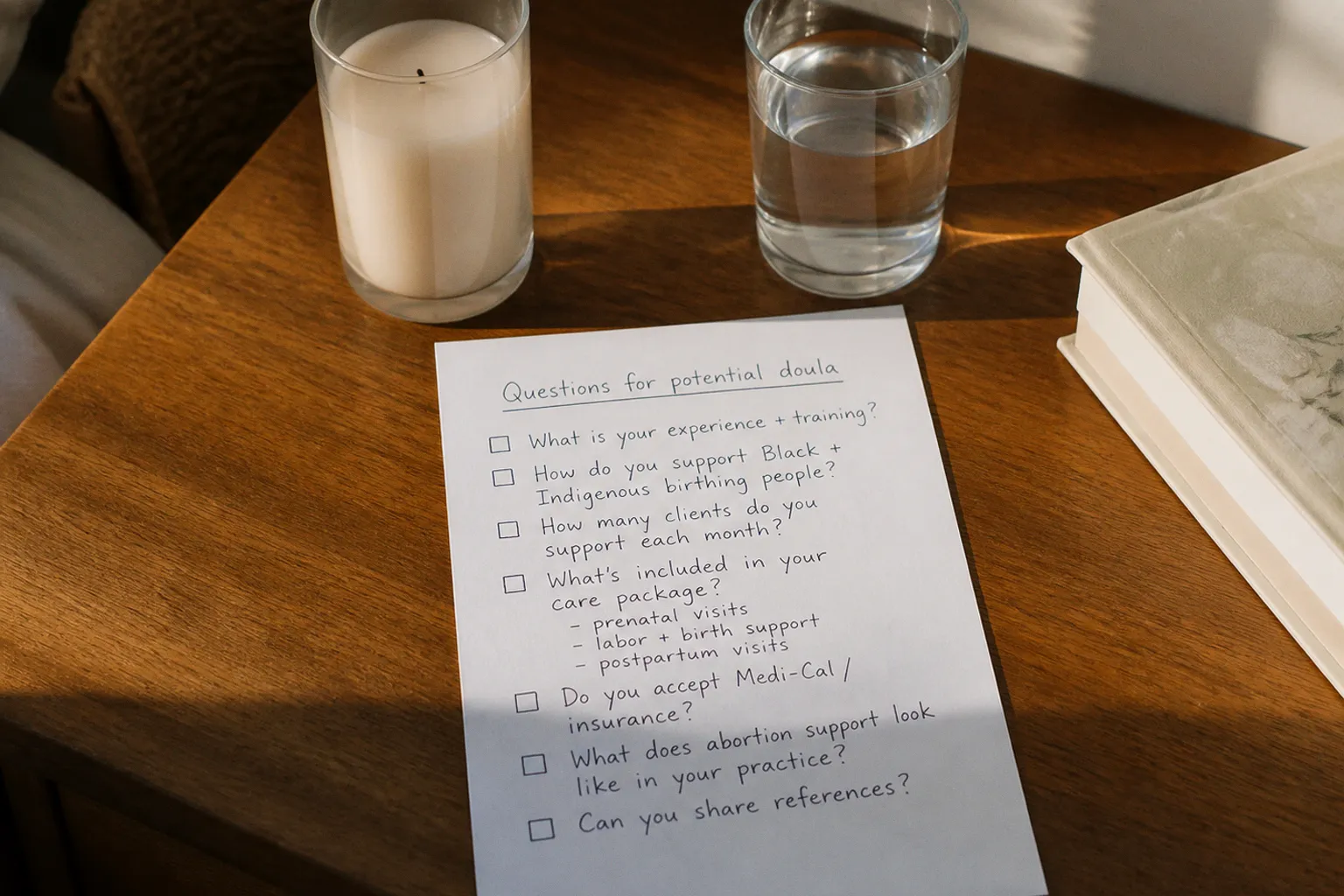
That interest is not abstract. It tracks directly onto a healthcare landscape where Black and Indigenous patients continue to face disproportionate maternal mortality and morbidity, and where birth is often treated as a clinical event rather than a life passage.
A doula, in this context, is not an extravagance. A doula can be a working piece of support infrastructure: someone whose role is to stay focused on the laboring person, explain hospital language, offer nonclinical comfort measures, and help keep the patient’s preferences visible when the medical team is moving quickly or rotating out.
Choosing one still requires more than finding a name in a directory. The relationship depends on cultural understanding, communication style, availability, backup coverage, cost, and a shared understanding of the doula’s role. Those questions matter for pregnant people from racial and ethnic minority backgrounds, queer and trans patients, disabled patients, immigrants, and anyone whose previous interactions with the healthcare system have been more adversarial than supportive.
The preparation is not about finding a doula who promises to control the birth. It is about finding a person who understands what they can contribute, is honest about what they cannot control, and has a realistic plan for supporting you when birth does not follow the original plan.
Why this preparation matters
Maternal health disparities in the United States are not a secret and not a new story. Black women are roughly three times more likely to die from pregnancy-related causes than white women, while Indigenous women face elevated risk in many regions. The gap persists even when researchers account for income and education. Its causes are layered: chronic stress from discrimination, gaps in insurance coverage, differences between hospitals and care teams, and the simple fact that being listened to during labor is not evenly distributed.
A doula’s role sits inside that gap, but does not erase it. Doulas are not clinicians. They do not perform examinations, deliver babies, prescribe medication, or replace obstetricians, midwives, nurses, or other members of the medical team. They can provide continuous emotional and physical support, help a patient and their support people understand what is happening, suggest comfort and positioning techniques, and encourage questions about consent and options.
For many minority patients, that support also has a social dimension. A doula may notice when a concern is being brushed aside, help a patient formulate a question, remind the room of a stated preference, or encourage the patient to ask for a clearer explanation before agreeing to an intervention. They should not speak over the patient or present themselves as a second clinician. Their value lies in helping the patient remain informed and involved.
A doula is one of the few people in the room whose attention is centered on the laboring person’s experience. Choose someone who understands the responsibility that comes with that attention.
Evaluating cultural competence and advocacy philosophy
The word “competence” does a lot of work in this space, and not all of it is honest. A doula who claims cultural competence because they completed a brief training is not automatically prepared to support every family. Training can matter, but it is only one part of the picture. What matters just as much is whether the doula can reflect on their own assumptions, recognize institutional bias, and respond without making the client educate them through a vulnerable experience.
Ask prospective doulas where they trained, who provided the training, and whether it included community-based work. Ask what populations they have supported and whether they have experience with the realities that concern you: being dismissed in triage, having pain reports minimized, being pressured toward an intervention without a full explanation, or having a partner or support person treated as an inconvenience.
You do not need to demand that a doula share every aspect of your identity. Shared identity can be meaningful, but it is not a substitute for skill, accountability, or respect. The more useful question is whether the doula has done the work to understand the communities they serve and can describe that work without turning your identity into a marketing credential.
Consider asking:
- How do you support clients who have experienced racism, discrimination, or medical trauma?
- What would you do if I told you that a clinician’s explanation did not feel clear or complete?
- How do you respond when a client’s preference conflicts with the usual workflow at a hospital?
- How do you support a patient who wants an epidural, a cesarean birth, or another intervention that is sometimes treated as a failure of birth planning?
- How do you work with same-sex partners, trans parents, single parents by choice, or families whose support structure does not fit a traditional model?
- Can you work with an interpreter, and do you speak the language in which I am most comfortable discussing pain, consent, and recovery?
- How do you handle religious, cultural, or family practices that I want included in the birth environment?
The way a doula answers matters as much as the answer itself. A thoughtful practitioner will be able to discuss limits and uncertainty. They should not claim that their presence will prevent mistreatment, guarantee a particular outcome, or override a medical decision. They should also not suggest that a patient must be calm, agreeable, or easy to work with in order to deserve respectful care.
You are also interviewing for an advocacy philosophy. Some doulas are highly verbal and proactive; others focus on quiet reminders and follow the client’s lead. Neither approach is automatically better. What matters is whether their style matches what you want. If you want a doula to remind you of questions, help you slow down a conversation, or prompt your support person to participate, say that directly. If you want them to remain in the background unless you ask for help, say that too.
A practical rule of thumb, drawn from the National Black Doulas Association, is to interview roughly three doulas before deciding. The number is not a law, and a smaller or larger search may make sense depending on your location and timeline. The value of speaking with several people is comparison: you can distinguish a genuine answer from a polished sales line and notice which concerns continue to matter after each conversation.
Navigating community-based doula support for systemic stressors
There is a meaningful difference between a freelance doula who takes private clients and a community-based doula who works through an organization, birth center, or public-health program. The distinction is not absolute, and the quality of care depends on the individual and the program. Still, the model can shape how a doula is trained, supervised, paid, and connected to the community.
Community-based programs are often designed around the needs of particular racial, ethnic, geographic, or economic communities. That can make them especially relevant for patients who are navigating systemic stressors alongside pregnancy. These stressors may include being spoken to dismissively, having pain concerns minimized, being separated from support people under institutional rules, facing language barriers, or having previous trauma activated by the clinical environment.
A community-based doula may be familiar with local hospitals, transportation difficulties, public-health programs, and the practical barriers that do not appear in a birth plan. They may also work as part of a team rather than as a solo practitioner. That can create stronger institutional accountability and a more reliable referral network, although it does not automatically guarantee better care or continuous one-to-one coverage.
If you are considering a community-based doula, ask whether the organization is led by people from the community it serves. Ask how doulas are trained and supervised, whether they are paid employees or independent contractors, and how the program handles turnover. Volunteer labor can be valuable, but a support system that relies entirely on unpaid work may be difficult to sustain when clients need reliable availability.
Ask about the organization’s relationship with your chosen hospital or birth center. A formal relationship may affect access, communication, or billing, but it does not mean the doula can direct hospital staff. Clarify what the doula is permitted to do in that setting and whether the program has encountered restrictions that could affect your care.
You should also ask how the program handles situations that require more than doula support. A responsible doula should know when to encourage contact with a clinician, social worker, therapist, lactation professional, or emergency service. Advocacy is not the same as practicing medicine, and a community-based model should make that boundary especially clear.
How the two main models compare
| Consideration | Private or freelance doula | Community-based doula program |
|---|---|---|
| Typical payment | Usually paid out of pocket, with fees varying by region and practitioner | May use a sliding scale and may be supported by grants, donations, or public-health contracts |
| Cultural specificity | Depends on the individual doula’s training, relationships, and caseload | Often designed around the needs of a particular racial, ethnic, geographic, or economic community |
| Client load | Depends on the doula’s schedule and whether they work alone or with a team | Depends on program capacity, staffing, funding, and the number of doulas available |
| Continuity of care | Often centered on one named doula, with backup coverage for conflicts | May include a primary doula and a program-based backup or team model |
| Insurance and Medicaid | May provide documentation for out-of-network reimbursement if available | May be enrolled as a Medicaid provider in states that reimburse doula care |
| Accountability | Established through the individual contract and professional references | May include organizational supervision, policies, and a formal complaint process |
Neither model is universally better. A private doula with deep community ties may provide highly individualized support. A community-based program may offer culturally grounded training, peer supervision, and a stronger connection to local resources. The question is not which label sounds more reassuring. It is which arrangement gives you clear expectations, dependable communication, and support that fits your actual circumstances.
Community-based does not mean informal, and private does not mean disconnected. Ask how the support is organized, not just what the service is called.
Standard service packages and client capacity
Pricing structures vary widely, and there is no single nationwide standard for what a doula package must include. The shape of a typical package is still useful to understand because it gives you something concrete to compare.
A standard package often includes:
- One or two prenatal visits, usually at your home, the doula’s office, or another agreed location
- Time to discuss your birth preferences, medical history, previous birth experiences, concerns, and support needs
- Phone or text availability during the pregnancy, with clear limits around response time
- Labor support beginning when you request it or when a previously agreed threshold is reached
- Continuous support through birth when the doula is available and able to attend
- One or two postpartum visits focused on adjustment, feeding, sleep, emotional wellbeing, and physical recovery
- A backup arrangement for illness, scheduling conflicts, or another birth occurring at the same time
Some doulas include attendance at prenatal appointments, childbirth education, lactation-specific visits, additional postpartum support, or other services. Some offer those services for an additional fee. None is automatically required. When comparing packages, separate the support you genuinely need from extras that sound appealing but do not address your main concerns.
The contract should explain when labor support begins, how the doula defines the period of availability, what happens if you are induced or have a planned cesarean birth, and how postpartum visits are scheduled. It should also state what happens if you change hospitals, go into labor before the doula can reach you, or decide that you no longer want the service.
Client capacity deserves the same attention as the package itself. The National Black Doulas Association notes that a practicing doula may carry three to six clients per month. That range is not a universal rule, but it illustrates the logistical problem: one person cannot be physically present at two simultaneous births. A doula with a large number of clients may still provide excellent care if they work in a well-organized team. The issue is whether the coverage plan is realistic and whether you understand it before signing.
Ask:
- How many clients do you expect to support around my due date?
- Do you accept clients with overlapping due dates?
- How many births have you attended at the hospital or birth center I am using?
- Who are your backup doulas, and can I meet them before labor?
- What happens if you are already supporting another client when I call?
- How do you decide when to come to the hospital?
- What is your response time by phone or text?
- Do you provide support if I am transferred to another hospital?
- What happens if I need an unplanned cesarean birth?
- Is postpartum support available after a difficult or unexpected birth?
The backup question is not an administrative footnote. It is part of the care itself. You should know whether the backup is one named person, a rotating list, or a larger agency team. You should know whether that person has access to your preferences and whether you have the option to speak with them ahead of time. A backup plan that exists only in the doula’s head is not a plan you can use.
Financial pathways: Medicaid, insurance, and sliding scale
Money is a real constraint, and pretending otherwise is unhelpful. The coverage landscape for doula care has shifted in recent years. California’s Medi-Cal program reimburses qualified doula services, and other state Medicaid programs have followed or are developing their own pathways. Some commercial health insurance plans also include doula coverage, although the details vary considerably.
The first financial question is therefore not simply how much the doula charges. It is how the service is billed and what portion, if any, you may have to pay yourself.
Ask prospective doulas:
- Are you enrolled as a Medicaid provider in my state?
- Do you bill Medicaid directly, or would I need to submit paperwork?
- Can you provide a superbill for out-of-network insurance reimbursement?
- Does your fee cover all prenatal, labor, and postpartum support, or are some services separate?
- Do you offer a sliding scale or payment plan?
- What deposit is required, and when is the remaining balance due?
- What happens financially if I cancel, transfer care, or have a birth that requires less support?
- Are backup services included if you cannot attend?
- Can you help me identify a community-based program if your fee is not affordable?
Many community-based programs operate on a sliding-scale model because the families they serve are often the same families least able to absorb a large out-of-pocket expense. Those programs may be funded through grants, donations, or public-health contracts. Eligibility can depend on location, insurance status, income, or other program requirements, so it is worth asking early rather than waiting until the final weeks of pregnancy.
Insurance language can be confusing. Coverage may have limits on the number of visits, require specific documentation, or apply only when the doula meets particular credentialing requirements. Do not assume that a general statement about doula benefits means the full fee will be reimbursed. Contact the insurer directly and ask what documentation is needed, whether preauthorization is required, and whether the doula must be in network.
The written agreement should be easy to understand. Be cautious of a doula who cannot explain the billing structure, refuses to provide a contract, or pressures you to pay in cash without documentation. The same caution applies in the other direction: a fee that seems unusually low may reflect limited availability, inadequate backup coverage, or a practice that is not financially sustainable. Low cost is not automatically a problem, but unclear terms are.
Interviewing strategies for finding your birth advocate
The interview is not a test you pass or fail. It is a working conversation, and like any working conversation it rewards preparation. Before the first interview, write down three things you want the doula to know about you, three things you want to know about them, and one non-negotiable. Bring that list. Use it.
The conversation should give you enough information to assess both competence and comfort. You are not looking for a performer who can tell the most reassuring birth story. You are looking for someone who can listen carefully, communicate under pressure, respect your decisions, and describe a workable response to uncertainty.
Three prompts are particularly useful:
1. Ask the doula to describe a birth that did not go as planned. Listen for a clear account of what was within their role and what was not. A doula who presents every difficult birth as a situation they personally rescued may have an inflated idea of their authority. A doula who can explain how they supported the client through changing circumstances is giving you more useful information.
2. Ask how they coordinate with your partner, co-parent, family member, or chosen support person. A good doula supports the team without displacing the people you have asked to be there. Ask how they divide comfort measures, communication, and practical tasks. Pay attention to whether the doula talks about collaboration or assumes that their approach should take over.
3. Ask what they would do if they could not attend your birth. The answer should include a real backup arrangement, not a vague assurance. Ask who the backup is, whether you can meet them, how information will be shared, and what happens if both the primary doula and the first backup are unavailable. Attendance depends on availability, timing, health, travel, and whether the doula is already supporting another client. A professional should be able to discuss that plainly.
You can also ask the doula to walk through a few specific situations:
- You report severe pain and feel that the response from staff is dismissive.
- A clinician recommends an intervention and you want time to understand it.
- Your support person is overwhelmed and needs guidance.
- You are transferred to a different hospital.
- Your birth preferences change during labor.
- You need emotional support after a birth that was medically safe but personally difficult.
Their response should preserve your agency. A doula can help you formulate questions, request clarification, remember preferences, and identify when you want your support person involved. They cannot force a clinician to follow a preference, interpret medical data as a substitute for a clinician, or make decisions for you.
After the interviews, give yourself time before signing anything. Talk with the people who belong in your decision-making process, if you want their perspective. Notice how you felt during the conversation. Did the doula make room for your questions? Did they answer directly? Did they treat your identity and concerns as ordinary parts of care rather than obstacles? Did they describe boundaries without becoming defensive?
A nagging concern is not proof that someone is unsafe, but it is information. You do not need a dramatic reason to choose another practitioner. A doula-client relationship involves trust, access, money, and vulnerability. If the fit is wrong, that is enough.
What a doula cannot do
A clear-eyed preparation process has to include limits. Doulas do not perform clinical tasks. They do not conduct vaginal examinations, monitor fetal heart rates, catch babies, prescribe medication, diagnose complications, or replace any member of your clinical care team. If a doula offers to perform those tasks, treats clinical advice as something they can overrule, or discourages you from contacting a medical professional, consider that a serious warning sign.
Doulas also cannot guarantee a particular outcome. Birth is unpredictable, and preparation cannot remove every medical, logistical, or emotional complication. A doula can offer presence, attention, comfort, and advocacy within the scope of their role. Attendance itself depends on availability and a workable backup plan; no individual doula can promise continuous in-person presence regardless of illness, timing, travel, or another simultaneous birth.
That distinction does not make doula support less valuable. It makes the agreement more honest. You should know who will contact you, who may attend if the primary doula is unavailable, how long the doula can remain with you, and how support will continue if circumstances change. You should also know that advocacy means supporting your voice and helping you stay informed, not guaranteeing that every request will be granted.
In a system where laboring people — particularly people of color, queer and trans people, disabled people, and patients with limited English proficiency — may be talked over, rushed, or ignored, having a prepared support person can matter. But the strongest doula relationship is not built on the fantasy that one person can protect you from every failure in the healthcare system. It is built on clarity: the doula knows their role, you know what to expect, and both of you have a plan for the moments that cannot be predicted.
The preparation is the point. Walking into a doula relationship with a clear sense of what you need, what is realistic, and what questions to ask turns a hopeful search into a working alliance. The interest reflected in the survey numbers at the start of this piece is already a form of recognition: many families see value in having support that is continuous, culturally aware, and centered on the patient’s experience.
The next step is not to find the most confident promise. It is to find the advocate who can offer steady support, honest boundaries, and a backup plan you can actually understand.