Ella vs copper IUD: two emergency contraception paths
When emergency contraception is needed, the decision is often framed as a simple choice between a pill and an IUD.
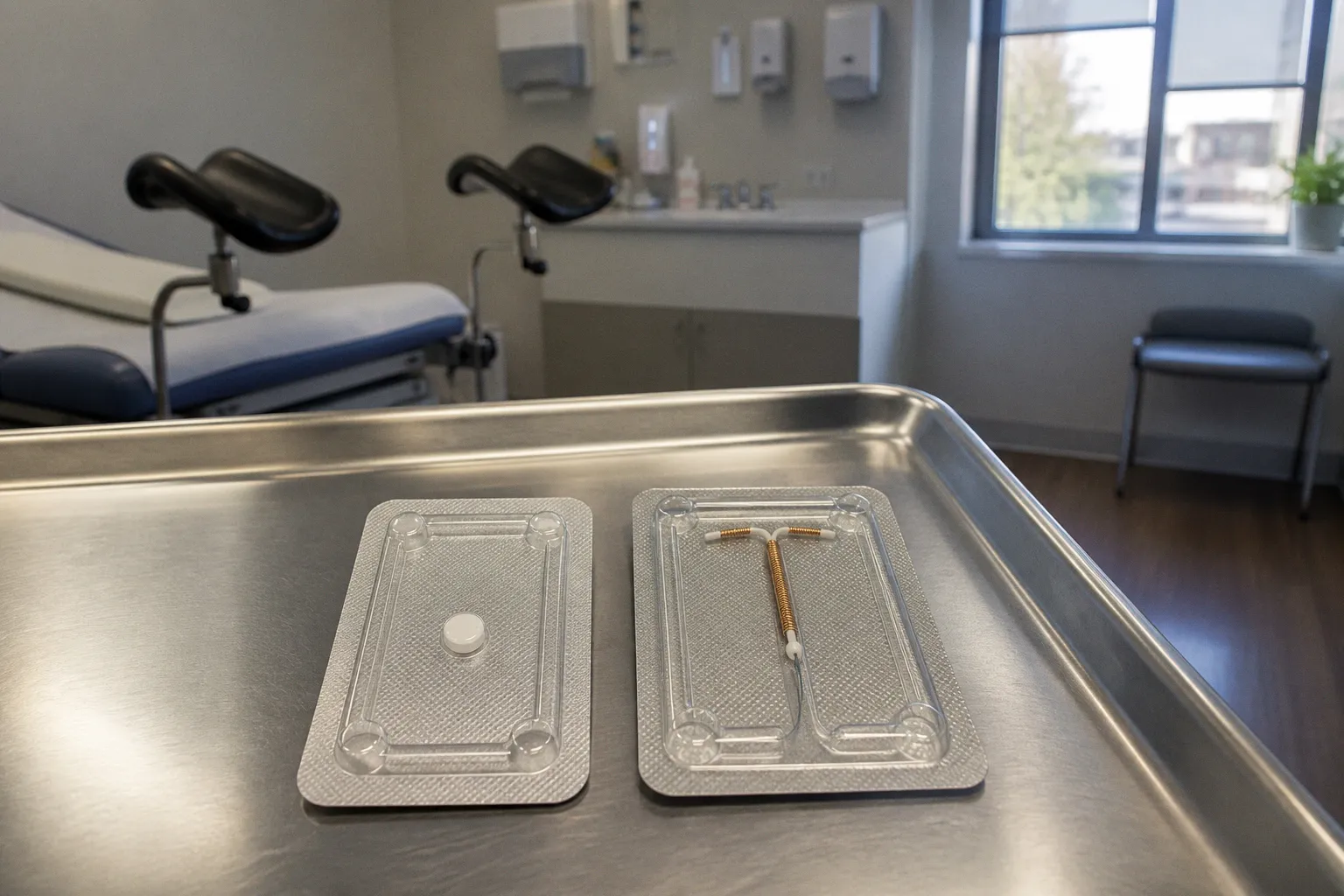
In practice, Ella and the copper IUD solve the same immediate problem in very different ways: one is a prescription medication taken at home, while the other requires a clinical insertion but can become a long-term contraceptive method at the same appointment.
Both can be used up to 120 hours—five days—after unprotected intercourse. The copper IUD is the most effective emergency contraception available, with effectiveness above 99%. Ella, which contains 30 mg of ulipristal acetate, remains a highly effective oral option throughout the five-day window and generally performs better than levonorgestrel emergency contraception later in that period.
The right route depends less on a theoretical ranking than on the clock, access to a clinician, body mass index, tolerance for an insertion procedure, and whether ongoing contraception is wanted.
How Ella and the copper IUD prevent pregnancy
Ella is an emergency contraceptive pill. Its active ingredient, ulipristal acetate, is a selective progesterone receptor modulator that primarily works by delaying or inhibiting ovulation. That distinction matters because emergency contraception works before a pregnancy begins: it is not an abortion medication and cannot disrupt an established pregnancy.
The copper IUD works locally in the uterus. Copper interferes with sperm movement and fertilization, making it extremely difficult for sperm to reach and fertilize an egg. When inserted within 120 hours of unprotected sex, it functions as emergency contraception and then continues working as a regular birth control method.
That difference creates the first major divide between the two options:
- Ella is a medication for the immediate situation. It can be taken without an insertion procedure, but it does not turn into a continuing contraceptive method.
- The copper IUD is both emergency contraception and ongoing birth control. Once inserted, it can prevent pregnancy for up to 10 years.
- Neither option protects against sexually transmitted infections. Emergency contraception addresses pregnancy risk, not STI exposure.
The copper IUD’s action also does not depend on whether ovulation can still be delayed. This is one reason it remains the most reliable emergency option when the timing of ovulation is uncertain. Ella works by postponing ovulation, so its usefulness depends on whether ovulation has already occurred.
The practical difference is not simply pill versus device. It is short-term rescue versus emergency contraception that can become a decade of ongoing protection.
Effectiveness: where the copper IUD has the clearest advantage
For emergency use, the copper IUD reduces the risk of pregnancy by more than 99% when inserted within five days after unprotected intercourse. It is the strongest option when the priority is maximum effectiveness, particularly when there are concerns about body weight or BMI.
The copper IUD’s performance is not affected by body mass index. That gives it an important advantage over oral emergency contraception, where the evidence and effectiveness may be less consistent at higher body weights. The available evidence does not establish one precise percentage by which Ella’s effectiveness changes at a BMI above 35 kg/m², so it is better not to reduce the issue to a neat cutoff. The clinically relevant point is simpler: the copper IUD is not known to lose its emergency-contraception effectiveness because of BMI.
Ella is more effective than levonorgestrel emergency contraception across the five-day window, especially when several days have passed since intercourse. Clinical studies have reported a failure rate for Ella in the range of approximately 0.9% to 2.1%. That is not the same as saying every person has exactly that level of protection: timing, ovulation status, and individual circumstances still matter.
The comparison becomes especially relevant after the first three days. Levonorgestrel products such as Plan B lose effectiveness over time and are significantly less effective after 72 hours. Ella retains more consistent efficacy through the full 120-hour window.
| Factor | Ella | Copper IUD |
|---|---|---|
| Type | Prescription emergency contraceptive pill | Intrauterine device inserted by a clinician |
| Active component | 30 mg ulipristal acetate | Copper device |
| Emergency-use window | Up to 120 hours, or five days | Insertion within 120 hours, or five days |
| Effectiveness | Highly effective; reported clinical failure range of about 0.9%–2.1% | More than 99% effective for emergency contraception |
| Effect of BMI | May be a consideration, although the exact impact at higher BMI is not established by one definitive figure | Effectiveness is not affected by BMI |
| Ongoing contraception | No; it is an emergency medication | Yes; protection can continue for up to 10 years |
| STI protection | None | None |
| Access | Prescription medication | Clinical appointment and insertion |
For someone who is already several days past intercourse and cannot obtain an IUD quickly, Ella is often the more useful oral emergency contraception option. For someone who wants the lowest possible pregnancy risk and a durable method afterward, the copper IUD has a different level of value.
The 120-hour window: timing changes the route
Emergency contraception should be treated as time-sensitive, but not as a situation where the first 24 hours are the only meaningful opportunity. Both Ella and the copper IUD can be initiated up to 120 hours—five days—after unprotected intercourse.
That does not mean waiting is beneficial. It means that a person who is already on day four has not necessarily missed the opportunity for effective emergency contraception.
A practical timeline looks like this:
1. Within the first three days: Ella and the copper IUD are both available emergency options, depending on access, preference, and clinical suitability. Levonorgestrel emergency contraception may also be available, but it becomes less effective as time passes.
2. Between 72 and 120 hours: Ella retains efficacy across the full window, making it an important oral option after three days. The copper IUD remains the most effective option if insertion can be arranged.
3. At any point in the five-day window: Access becomes part of the medical decision. A theoretically superior method is not useful if an appointment cannot be obtained before the window closes.
4. After the window: A clinician or qualified health service should help assess what options remain. Do not assume that every emergency pill or device follows the same timing rules.
The phrase “emergency IUD insertion timeline” can sound more complicated than it is. The key deadline is five days after unprotected intercourse. The practical difficulty is arranging a visit with a clinician who can provide the device, assess whether insertion is appropriate, and complete the procedure within that timeframe.
If there have been several episodes of unprotected intercourse in the same cycle, the date of the most recent episode may not tell the whole story. A clinician may need to review the timing of all relevant intercourse, menstrual-cycle information, and any existing contraception. This is one reason a phone or telehealth consultation can be useful even when the final intervention must happen in person.
Ella after three days: why it is not interchangeable with Plan B
People often use “morning-after pill” as though it refers to one medication. It does not. Emergency contraceptive pills contain different active ingredients, and their performance changes differently over time.
Ella contains ulipristal acetate and is designed to delay ovulation. It can be used through 120 hours after unprotected sex and maintains more consistent efficacy over that period. Levonorgestrel emergency contraception is more time-sensitive and loses effectiveness as the interval lengthens, with a notable decline after 72 hours.
That makes Ella particularly relevant for the search question behind “emergency contraception options after three days.” The answer is not that every pill remains equally useful. Ella is the oral option in this comparison with evidence of consistent efficacy through the five-day window.
Still, Ella is not a substitute for the copper IUD in every respect. It does not provide continuing pregnancy prevention for the rest of the year, let alone the next decade. It also may be less attractive for someone who wants to avoid repeating emergency contraception or who knows that adherence to a regular method will be difficult.
The choice can be understood through four questions:
- How much time has passed since unprotected intercourse? Ella remains an option through five days; the copper IUD does too if insertion is completed in time.
- Is the priority the highest available emergency effectiveness? The copper IUD has the clearest advantage.
- Is BMI a concern in choosing an oral method? The copper IUD’s effectiveness is not affected by BMI.
- Is ongoing contraception wanted? The copper IUD provides it; Ella does not.
From emergency use to long-term family planning
Emergency contraception is often treated as an isolated event, but the method selected can shape what happens next. The copper IUD offers an unusually direct transition from urgent pregnancy prevention to long-term family planning.
After insertion, the copper IUD can provide contraception for up to 10 years. That may suit someone who wants a highly effective, non-hormonal method without a daily pill, recurring prescription, or repeated pharmacy access. It can also be removed if reproductive plans change.
The trade-off is that an IUD requires an in-person clinical procedure. Some people will consider that a reasonable exchange for years of contraception. Others will prefer a pill because they do not want an insertion or cannot access a clinic quickly.
Ella has the opposite profile. It is temporary and relatively simple to use once prescribed, but the emergency episode remains separate from longer-term contraception. A person who takes Ella and does not want another pregnancy still needs to decide what method to use afterward.
That follow-up decision should not be rushed into a method that does not fit. Emergency contraception is a moment for preventing an immediate pregnancy; it is not a requirement to choose a permanent-feeling contraceptive strategy on the same day. The copper IUD happens to combine the two functions, but combination is an option, not an obligation.
There is also a timing issue after taking Ella. Because ulipristal acetate works through progesterone-related mechanisms, starting or restarting a hormonal contraceptive may require specific timing and professional guidance. The instructions supplied with the medication and advice from a pharmacist or clinician should take priority. Do not improvise a transition from Ella to another hormonal method based on assumptions about how emergency pills work.
Access: prescription, insertion, and the cost of delay
Ella is a prescription oral medication in the context described here. That means access may depend on a clinician, a pharmacy, local prescribing rules, and whether a prescription can be obtained promptly. Availability differs by country and healthcare system, so the existence of Ella as an emergency option does not guarantee that it will be immediately accessible everywhere.
The copper IUD requires more than obtaining a product. A trained clinician must insert it, and the service must have the device available. Appointment availability can be the limiting factor, especially near the end of the five-day window.
This creates a practical decision rule: contact the fastest appropriate source of care as soon as possible and ask specifically about emergency contraception, Ella, and copper IUD insertion. A general appointment several weeks away is not an answer to a five-day deadline.
Costs also vary by location, insurance status, clinic, and whether the service covers the device and insertion separately. There is no single reliable out-of-pocket price that applies across regions. Before committing to an appointment, ask what the quoted cost includes, whether the device is stocked, and whether the clinician provides emergency insertion rather than only routine IUD placement.
For people facing barriers to care, the access question is not a side note. A method that is technically available but practically unreachable is not an actionable option. Pharmacies, sexual-health clinics, primary-care services, telehealth providers, and reproductive-health organizations may have different prescribing and referral pathways. The fastest route is usually the one that confirms both eligibility and availability rather than sending someone through a general booking system.
A five-day window is generous only on paper. In real life, the clock includes prescription delays, pharmacy stock, appointment availability, and travel to a clinician who can perform the insertion.
What both methods can—and cannot—do
Ella and the copper IUD prevent pregnancy before it begins. They do not terminate an established pregnancy and should not be described as abortion methods.
Neither method protects against STIs. If the unprotected intercourse involved a possible STI exposure, emergency contraception does not replace testing, treatment, or barrier protection. Those are separate health decisions with their own timing.
Neither method is a guarantee against pregnancy in every circumstance. Ella’s action depends on delaying ovulation, while the copper IUD provides the strongest emergency protection but requires timely insertion. A late period, unusual bleeding, or symptoms that raise concern should be discussed with a healthcare professional rather than interpreted from general information alone.
It is also worth separating emergency effectiveness from long-term convenience. A method can be excellent for one purpose and less suitable for another:
- Ella is a strong oral option when intercourse occurred within the previous five days, particularly when more than 72 hours have passed.
- The copper IUD offers the highest emergency-contraception effectiveness and can continue working for up to 10 years.
- Ella may be the realistic option when an IUD appointment cannot be secured in time.
- The copper IUD may be the more efficient choice when emergency contraception and ongoing birth control are both wanted.
- Neither method addresses STI risk.
Choosing between Ella and the copper IUD
There is no need to turn this decision into a contest between people who prefer pills and people who prefer devices. The useful comparison is between two different care pathways.
Ella may make more sense when:
- obtaining a prescription is faster than arranging an IUD insertion;
- intercourse occurred between 72 and 120 hours ago;
- a person does not want an intrauterine device;
- long-term contraception is not being chosen at this moment.
The copper IUD may make more sense when:
- the goal is the most effective available emergency contraception;
- BMI-related uncertainty about oral emergency contraception is a concern;
- an in-person insertion can be completed within five days;
- ongoing contraception for years is desirable;
- avoiding hormonal contraception is a priority.
In both cases, speed matters. If the copper IUD is preferred, begin looking for an insertion appointment immediately rather than waiting to see whether a routine clinic can fit the request in. If Ella is preferred, ask a prescribing clinician or pharmacy about availability and the five-day timeframe as soon as possible.
The central distinction is straightforward: Ella is the practical prescription pill with strong performance through 120 hours; the copper IUD is the most effective emergency option and the only one of the two that becomes long-term contraception. For some people, access will decide the answer. For others, BMI, desire for a non-hormonal method, or the prospect of up to 10 years of protection will make the decision clearer.
Emergency contraception should expand reproductive choice, not narrow it. The best option is the one that can be obtained in time, fits the person’s health circumstances and preferences, and makes sense for what happens after the immediate risk has passed.