Birth control checklist: what to gather before your visit
The first birth control appointment can feel like a pop quiz you did not study for.
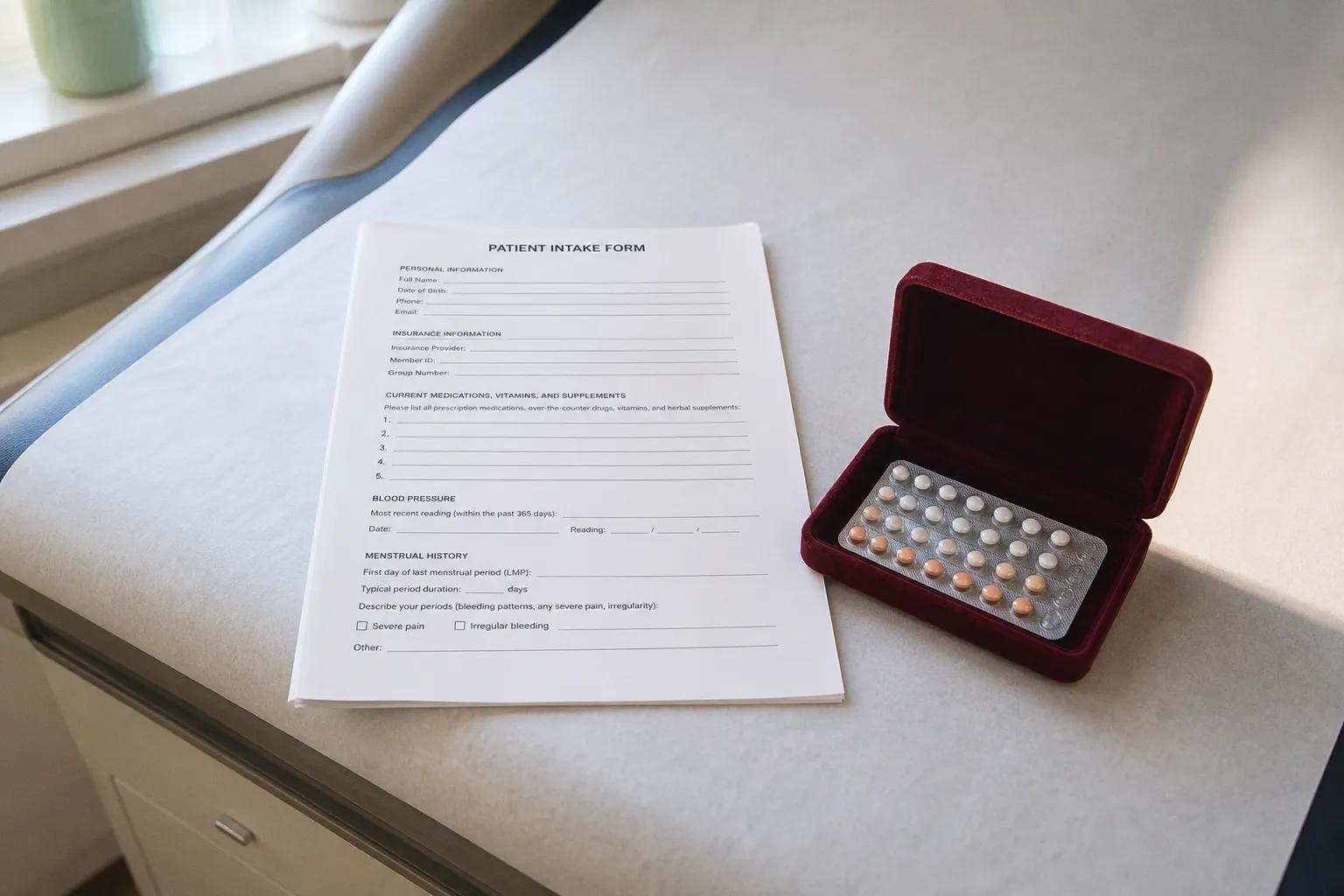
A clinician may need to make several safety decisions in a short visit, and the questions they ask — about your cycle, blood pressure, migraine symptoms, family history, medications, and pregnancy possibility — are not small talk. They help determine whether a combined pill, patch, or ring is appropriate; whether a progestin-only method would be a better fit; or whether an implant, IUD, injection, or nonhormonal option belongs in the conversation.
Preparation does not guarantee that you will leave with a method that day. A clinician may need more information, a separate procedure appointment, or evaluation of a symptom that has not been investigated. But arriving with the relevant details makes the consultation more useful and gives you a better chance of making a decision based on your health and priorities rather than on whatever you happen to remember under pressure.
The practical aim is simple: gather the information that affects safety, know which examinations are actually connected to the method you want, and bring questions about how that method will work in your life. A blood pressure reading is one essential safety check for combined hormonal contraception, but it is not the only factor that matters. A routine pelvic exam is usually not needed to start pills, the patch, the ring, the implant, or the injection. An IUD insertion is different: the clinician generally needs to examine the pelvis and inspect the cervix as part of placing the device.
The logistics: ID, insurance, and what to physically bring
Start with the administrative details, because they can determine what happens after the clinical conversation. Bring a photo ID if the clinic requires one, your insurance information, and a pharmacy card if it is separate from your insurance card. If you are using telehealth, ask in advance how the clinic will verify your identity, send a prescription, and handle any measurements that cannot be taken remotely.
If you are uninsured or underinsured, mention that when you book the appointment rather than waiting until the end of the visit. A clinic may be able to direct you to a Title X-funded provider, a sliding-scale service, a community health center, or a patient assistance program. Coverage and prices can vary by clinic, pharmacy, formulation, and method. The visit fee, the cost of the medication or device, and the cost of insertion are not always bundled together, so ask what each part involves before you arrive.
For a telehealth appointment, find out whether the clinician needs a recent blood pressure reading from a pharmacy, primary-care office, community clinic, or validated home monitor. If you use a home monitor, write down the date and the reading rather than relying on memory. One isolated number may not tell the whole story, especially if it was taken when you were ill, anxious, or using a device that was not positioned correctly. Still, a current measurement is important when you are considering combined hormonal contraception, because elevated blood pressure can change whether estrogen-containing methods are safe.
Bring an actual medication list, either on paper or in your phone. Include:
- Prescription medicines, with the dose and how often you take them.
- Over-the-counter pain relievers, antihistamines, sleep aids, and cold medicines.
- Vitamins, minerals, herbal products, and supplements.
- Medicines you take only occasionally, such as a seizure medication or a treatment for migraines.
- Recent antibiotics or short courses of medication if you are still taking them or expect to take them again.
- Allergies and the type of reaction you had.
The useful part is specificity. The name of the product, its dose, and its schedule allow a clinician to check whether it affects contraceptive effectiveness or whether contraception could affect another treatment. A photograph of the labels can work if making a written list is difficult.
| Category | What to bring or write down |
|---|---|
| Identification and coverage | Photo ID, insurance card, pharmacy card, and any financial questions |
| Current medicines | Names, doses, schedules, occasional medicines, vitamins, and supplements |
| Recent vitals | A recent blood pressure reading if you are considering a combined hormonal method |
| Cycle information | First day of the last menstrual period, usual cycle length, bleeding pattern, and pain |
| Medical history | Personal and family history of clots, stroke, high blood pressure, migraines, liver disease, cancer, and other major conditions |
| Pregnancy and sexual health | Possible pregnancy, recent unprotected sex, contraception used recently, and concerns about sexually transmitted infections |
| Your priorities | Hormonal or nonhormonal preference, bleeding goals, privacy concerns, cost, and how often you want to think about contraception |
| Questions | Side effects, effectiveness, backup contraception, missed doses, stopping, and follow-up |
You do not need to arrive with a perfect dossier. The point is to reduce avoidable gaps in the history, not to turn a routine appointment into a research project.
Your cycle: the calendar you did not know you needed
The first day of your last menstrual period — often abbreviated as LMP on medical forms — is one of the most useful dates to have ready. Providers use it, along with information about recent sex and contraception, to assess the likelihood of pregnancy and decide whether a method can be started immediately. Depending on the circumstances, they may recommend a pregnancy test, a period of backup contraception, or follow-up testing after the method has been started.
The LMP is not a guarantee that you are not pregnant. Periods can be irregular, bleeding can be mistaken for a menstrual period, and ovulation does not always follow a predictable schedule. Tell the clinician if you have had sex without reliable contraception since your last period, if you recently stopped another method, or if your bleeding was unusual. These details are more useful than trying to make the dates sound tidier than they were.
Beyond the last period, note your usual cycle length, how long bleeding lasts, and whether the pattern has changed. It is also worth recording:
- Whether bleeding is light, moderate, or heavy for you.
- Spotting between periods or bleeding after sex.
- Severe cramps, pelvic pain, or pain with sex.
- Symptoms that occur before or during bleeding, including migraines.
- Whether your periods have recently become much less predictable.
- Any bleeding that has already been evaluated or treated.
Irregular bleeding does not automatically rule out a contraceptive method. It may, however, affect the conversation. A clinician may want to understand whether the pattern is related to pregnancy, an infection, a medication, a hormonal condition, fibroids, endometriosis, or another cause. Heavy bleeding and severe pain can also influence which method is likely to make your life easier. Hormonal IUDs and some combined hormonal methods may reduce bleeding or menstrual pain for many people, while a copper IUD can make bleeding and cramping heavier, particularly early on.
If you have kept previous records, bring them when they are easy to access. A prior ultrasound, a medication history, a note about anemia, or documentation of a previous reaction to contraception may prevent the new clinician from starting from zero. Reproductive health records often end up scattered across primary care, urgent care, sexual health clinics, and specialists. A clear summary is sometimes more useful than a stack of documents.
Tracking does not have to mean using an app. A paper calendar or notes on your phone are enough. If privacy is a concern, consider whether an app stores data in a way you are comfortable with, particularly if someone else can access your phone or account.
Bring the date of your last period, but bring the uncertainty around it too. A clinician can work with incomplete information; they cannot work with information you feel pressured to make precise.
Medical history: the details that change the risk conversation
The medical history for contraception is not a formality. Estrogen-containing combined methods — the combined pill, patch, and vaginal ring — can be unsafe for some people with conditions that increase the risk of blood clots, stroke, or cardiovascular complications. Progestin-only methods and nonhormonal methods have different considerations, which is why a condition that makes one option unsuitable may leave several others available.
Before the appointment, think through whether you have ever had:
- A blood clot in the leg or lung, or treatment for a clotting disorder.
- A stroke, heart attack, or other significant cardiovascular disease.
- High blood pressure, especially if it is untreated or difficult to control.
- Migraine with aura.
- Liver disease or a liver tumor.
- Breast cancer or a history of breast cancer.
- Diabetes with vascular complications or a long duration of illness.
- A major operation, prolonged immobility, or a recent period when you could not walk normally.
- A condition or medicine that affects bleeding or clotting.
- A serious reaction to a previous contraceptive method.
The list is not a self-diagnosis tool. Its purpose is to help you remember what to disclose and to give the clinician enough context to apply the relevant guidance. The answer may depend on how active a condition is, how it is treated, your age, other risk factors, and the particular contraceptive method.
Smoking matters in the discussion of combined hormonal contraception, especially for people over 35. The clinician may also ask about vaping or nicotine use, although the evidence and recommendations are not identical to those for cigarette smoking. Be straightforward about frequency. This is not a character assessment; it is information that can change the balance of risks.
Blood pressure deserves attention, but it should not be mistaken for the entire safety assessment. A recent blood pressure measurement is an important requirement before starting a combined hormonal method, yet a normal reading does not cancel out a history of blood clots, migraine with aura, certain liver conditions, breast cancer, smoking-related risk, postpartum complications, or medication interactions. Conversely, a single elevated reading does not always settle the question by itself. The clinician may repeat it, review previous readings, or recommend evaluation rather than making a decision from one anxious moment.
Migraines and aura
Migraine questions are often difficult because people use the word migraine to describe very different experiences. Aura refers to neurological symptoms that can occur before or during a headache, such as temporary visual changes, flashing or zigzag patterns, blind spots, numbness, tingling, or trouble speaking. A severe headache without these symptoms is not automatically migraine with aura, and not every person with migraine experiences aura.
Write down what happens before and during your headaches, how long symptoms last, and whether the neurological symptoms are new. If you have been diagnosed with migraine but do not know whether aura is part of it, say exactly that. Guessing can lead to an unnecessarily narrow choice, while a precise description helps the clinician decide whether a specialist assessment or a different contraceptive option is appropriate.
Family history without the vague version
Family history is most useful when it includes the relationship, condition, and approximate age at diagnosis. A general statement that heart disease runs in the family is harder to act on than information that a parent had a stroke at a young age or a sibling was treated for a blood clot. Tell the clinician about close relatives with blood clots, stroke, heart attack, very high blood pressure, or known inherited clotting conditions.
A family history does not automatically prohibit every hormonal method. It provides context for assessing your own risk, particularly when combined with smoking, migraine, age, recent surgery, immobility, or personal medical history. If a relative had a clot, note whether doctors identified a cause, whether testing found an inherited condition, and whether other relatives were affected. If you do not know, say so.
Medications, supplements, and the enzyme-induction problem
Hormonal contraception does not operate separately from the rest of your medication list. Some medicines speed up the liver enzymes that break down contraceptive hormones. Others can affect absorption, or their own effectiveness may be affected by a contraceptive. The answer is often method-specific, so do not assume that a warning about pills applies equally to an implant, injection, patch, ring, or IUD.
Rifampicin and rifabutin, medicines used in some tuberculosis treatment regimens, are important examples of enzyme-inducing drugs. Several anti-seizure medicines, including phenytoin and carbamazepine, can also reduce the effectiveness of some hormonal methods. Certain barbiturates and other enzyme-inducing medicines may have similar implications. If you take medication for seizures, tuberculosis, HIV, or another condition that requires long-term treatment, ask for a method-by-method review rather than a generic statement about hormonal birth control.
St. John’s wort is another product worth naming. It can affect the metabolism of hormonal contraceptives and is easy to omit because it is sold as an herbal supplement rather than prescribed. Tell the clinician about it even if you take it only intermittently. Other supplements may not reduce contraceptive effectiveness, but they still belong on the list so the clinician can check for interactions and avoid making assumptions.
Emergency contraception is part of the same conversation. Some medicines can affect which emergency contraceptive is most suitable, and the timing of regular contraception after emergency contraception can matter. If you are asking for emergency contraception or have used it recently, include the product and the date.
| Medication or product category | Why it matters | What to ask |
|---|---|---|
| Rifampicin or rifabutin | Can lower the hormone levels of some contraceptive methods | Which methods remain reliable during treatment and for the relevant period afterward? |
| Certain anti-seizure medicines | Some induce liver enzymes and can reduce effectiveness | Does my medicine affect the pill, patch, ring, implant, or emergency contraception differently? |
| St. John’s wort | May reduce the effectiveness of some hormonal contraception | Should I stop it, change methods, or use additional protection? |
| HIV treatment and other specialist medicines | Interactions vary by the exact regimen | Can the clinician review the full medication combination rather than the drug class alone? |
| Medicines affecting absorption | May matter most for oral methods and timing | Should I use a nonoral method or follow special instructions? |
The sensible rule is not to stop a prescribed medicine because you want to start contraception. Bring the full list and let the prescribing clinicians coordinate. In some cases, a long-acting or nonoral method avoids an interaction; in others, the existing medicine can be continued with a different contraceptive plan or additional protection.
What needs to be examined before a method starts?
Not every contraceptive method requires the same preparation. This is where broad statements about examinations create confusion. The absence of a need for a routine pelvic exam does not mean that no method ever involves an examination.
For pills, the patch, and the vaginal ring, a clinician generally needs a relevant medical history and a current blood pressure measurement, along with an assessment of pregnancy possibility. A pelvic exam is not routinely required just to prescribe these methods. The implant and injection also do not usually require a routine pelvic exam for initiation. Other tests may be recommended because of symptoms, pregnancy concerns, medication use, or a separate health issue, but they are not automatically part of every contraception visit.
A Pap test is different from a pelvic exam and is a screening test for cervical cancer. It may be due according to your age, history, and local recommendations, but being due for cervical screening does not usually mean that you must delay starting a contraceptive method. Similarly, screening for sexually transmitted infections may be appropriate based on your sexual history, symptoms, pregnancy, or the method being considered. STI screening and contraceptive initiation can often be handled in the same visit, and an STI screen is not the same thing as a requirement for a routine pelvic exam.
IUDs require a separate level of preparation
An IUD is the important exception to keep clear. Before inserting a copper or hormonal IUD, the clinician generally performs a pelvic examination, including a bimanual examination and inspection of the cervix, to assess the uterus and identify conditions that could make insertion unsafe or require further evaluation. The cervix must be accessed for the procedure, and the provider needs to confirm that an IUD is appropriate to place.
That does not mean every person considering an IUD needs a pelvic exam before they can discuss it, nor does it mean that a Pap test or a full set of infection tests must always be completed in advance. Depending on symptoms, history, and local practice, some screening can be done at the time of insertion or arranged separately. A clinician may postpone insertion if there are signs of a pelvic infection, unexplained bleeding, a positive pregnancy test, or another concern that needs attention first.
Ask what the appointment is actually scheduled to include. A consultation about an IUD may be separate from the insertion, or the clinic may offer both on the same day if the necessary assessment can be completed. Knowing this in advance helps you plan for time, transportation, pain management, and privacy.
A routine pelvic exam is not a universal entrance fee for contraception. It becomes part of the process when the method or the symptoms make a pelvic assessment clinically relevant — especially for IUD insertion.
If a provider asks you to return for an exam before prescribing pills, the useful question is not whether pelvic exams are ever important. Ask what the exam is intended to assess, whether a symptom or medical history makes it necessary, and whether the prescription can be started while any separate screening is arranged. Clinic workflows vary, and a provider may have a reason that is specific to your situation. You are entitled to know what that reason is.
Questions worth taking into the room
A consultation is easier to navigate when your priorities are stated plainly. You do not need to choose a method before you arrive. You do need to tell the clinician what you want the method to do and what you would rather avoid.
For example, your priorities might include:
- Preventing pregnancy without having to remember a daily pill.
- Avoiding estrogen because of migraine, blood pressure, smoking, or personal preference.
- Keeping hormones out of the method.
- Making periods lighter or reducing menstrual pain.
- Avoiding irregular bleeding if possible.
- Having a method that is private from a partner or family member.
- Being able to stop the method without a procedure.
- Keeping the cost low or avoiding a recurring pharmacy pickup.
- Planning a pregnancy soon, or wanting a method that can be used for several years.
Then ask questions that connect the method to those priorities:
- How quickly does this method become effective, and will I need backup contraception at the start?
- What bleeding changes are common in the first few months?
- Which side effects should I expect, and which ones should prompt a call or urgent care?
- What should I do if I miss a pill, remove the patch late, or change the ring outside the recommended schedule?
- If I vomit or have severe diarrhea, does that affect an oral method?
- Which medicines or supplements could make this method less reliable?
- How will this method affect acne, heavy bleeding, cramps, or menstrual migraines?
- How is the method stopped or removed, and how quickly can fertility return after stopping?
- What is the plan if I dislike the method after a few weeks?
- When should I follow up, and who should I contact if a problem comes up?
If you already have a preference, say so without treating it as a final commitment. A person who is considering a copper IUD because they want a nonhormonal method has given the clinician useful direction. So has someone who wants a hormonal IUD because heavy bleeding is exhausting, or someone who does not want an implant because they are uncomfortable with a procedure in the arm. The point of the visit is not to prove that your first idea was perfect. It is to test that idea against your health, preferences, and practical circumstances.
Bring online concerns into the room too. Weight changes, mood, blood clots, acne, future fertility, and pain with insertion are common reasons people hesitate. A clinician should be able to separate a genuine warning sign from a risk that is being misunderstood, explain what is known and uncertain, and offer an alternative if the concern remains unacceptable to you.
Plan for the appointment you are actually having
A new-patient visit, a method switch, an IUD consultation, and a prescription renewal are not interchangeable. When booking, say whether you are starting contraception for the first time, changing from another method, seeking emergency contraception, considering an IUD, or bringing a complex medical history. Ask whether the clinic can provide the method on the same day or whether insertion, testing, or counseling requires another appointment.
If you are considering an IUD or implant, ask about pain-relief options, expected aftercare, and whether you should eat or take any regular medication before the visit. Do not take a new medicine solely because someone online recommended it without checking with the clinic. If you are worried about pelvic pain, fainting, prior difficult procedures, trauma, or a previous bad experience, tell the staff when you book. That information can affect how the appointment is arranged.
Also ask about confidentiality if privacy is a concern. Insurance explanations of benefits, shared pharmacy accounts, patient portals, and phone notifications can reveal care to another person. A clinic may have specific ways to communicate discreetly, but it needs to know that privacy is part of the healthcare problem you are trying to solve.
The point of arriving prepared
The useful preparation is modest: a medication list, a recent blood pressure reading when relevant, the date and pattern of your last periods, a clear account of major health conditions, and a few questions you actually want answered. You do not need to predict every clinical issue before the appointment.
Preparation also should not become another barrier. If you do not know the exact date of your last period, cannot access old records, or have no recent blood pressure reading, book the visit anyway and say what is missing. The clinic may be able to measure your blood pressure, obtain records, assess pregnancy possibility, or arrange follow-up. A missing detail is a reason to ask for help, not a reason to delay care indefinitely.
The safest method is not determined by one number or one examination. Blood pressure is a key screen for combined hormonal contraception, while medical history, migraine symptoms, clotting risk, smoking, postpartum status, medications, and personal priorities also matter. Routine pelvic examination is generally not required for starting most methods, but IUD insertion requires an examination of the pelvis and cervix as part of the procedure.
That distinction is the practical value of a birth control appointment preparation checklist. It helps you bring the information that can change the decision, challenge requirements that do not apply to your situation, and make room for the questions that determine whether a method will work outside the clinic. The goal is not simply to leave with contraception. It is to leave with a method you understand, can use consistently, and can change if it does not fit your life.