Estrogen-free birth control: which option fits your body?
Estrogen-free birth control options are no longer limited to a narrow group of prescription pills.
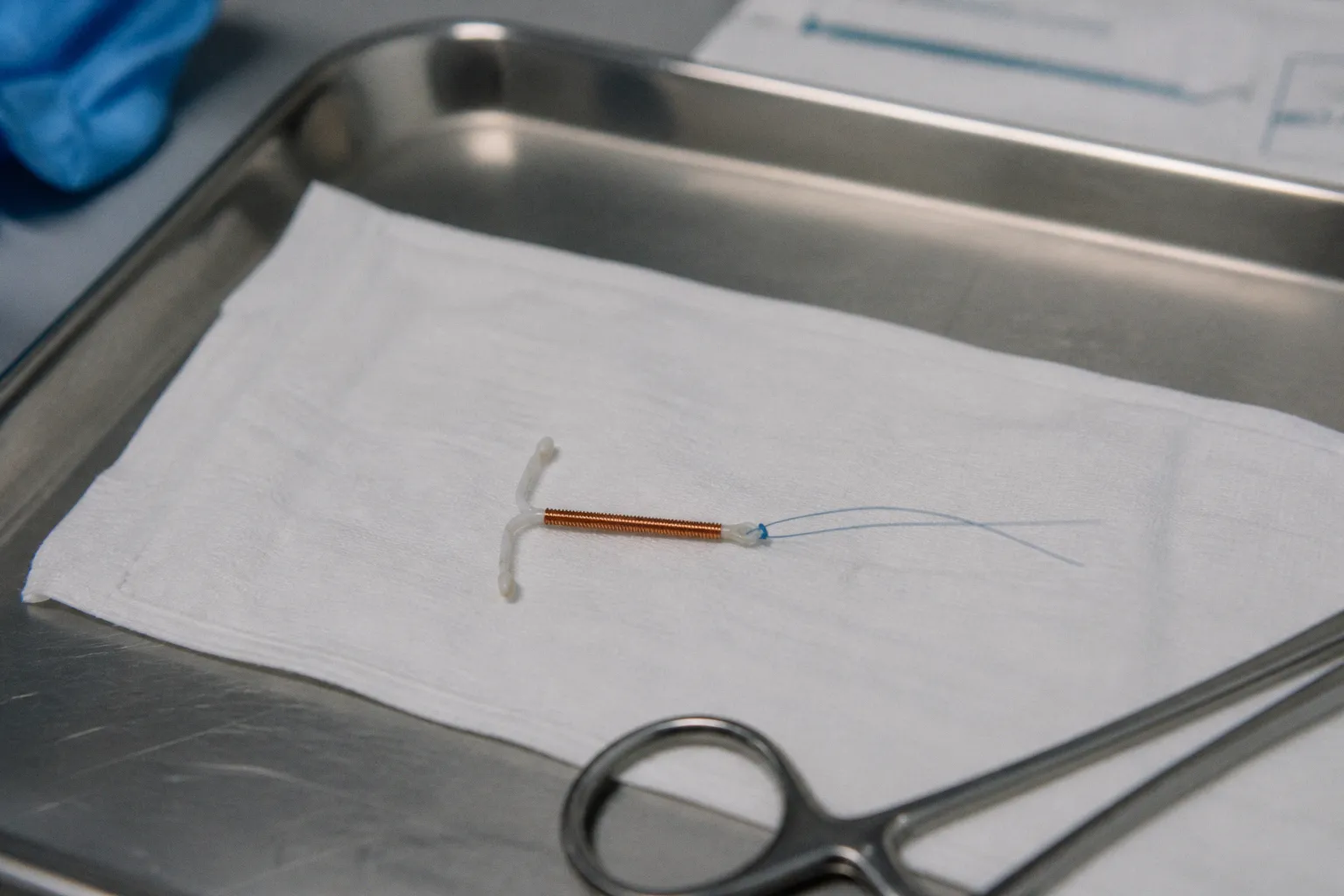
Today, people who cannot use estrogen—or simply do not want it—can choose among an over-the-counter daily pill, prescription progestin-only contraceptives, hormonal IUDs, implants, injections, copper IUDs, and barrier methods.
That wider menu matters because estrogen is not a neutral ingredient for everyone. Combined hormonal contraceptives, which contain both estrogen and progestin, can raise the risk of venous blood clots. For someone with a clotting disorder, certain cardiovascular risk factors, or severe migraine patterns, a birth control method without estrogen may offer a more appropriate route to pregnancy prevention. For others, the decision is less about a formal contraindication and more about tolerability, convenience, bleeding patterns, or control over what enters the body.
The practical question is not whether birth control without estrogen is effective. Several options are. The real question is which trade-off fits your health history and daily life: a pill that must be taken on schedule, a device that works for years, a method that requires no hormones, or a barrier method that also helps reduce STI transmission.
Why estrogen-free methods matter for cardiovascular health
Combined pills, patches, and rings use estrogen together with a progestin. Estrogen helps stabilize bleeding and prevents ovulation, but it also changes the clotting environment in the body. That increased risk of venous thromboembolism is one reason clinicians may recommend estrogen-free contraception for people with certain cardiovascular risks or a history of blood clots.
This does not mean every person who has ever experienced a headache, elevated blood pressure reading, or family history of illness must avoid estrogen. The decision depends on the specific condition, its severity, current treatment, age, smoking status, blood pressure, and other risk factors. But the distinction between combined and progestin-only contraception is clinically meaningful—not merely a marketing label.
Estrogen-free methods may be considered when someone:
- has a history of blood clots or a known clotting disorder;
- has cardiovascular risk factors that make estrogen less suitable;
- experiences migraine with aura, where combined hormonal contraception may be inappropriate;
- is postpartum or breastfeeding and wants to avoid estrogen during a period when it may not be recommended;
- prefers to avoid estrogen-related side effects such as breast tenderness, nausea, or fluid retention;
- wants contraception that does not rely on the same hormone combination as a previous method.
The phrase “estrogen-free” covers several very different technologies. A progestin-only pill is not interchangeable with an implant, and neither is equivalent to a copper IUD. They differ in how much user action they require, how quickly fertility returns after stopping, how they affect bleeding, and which medical conditions need extra attention.
Estrogen-free contraception is not one method with several brand names. It is a group of very different routes to the same goal.
A method can be medically suitable and still be a poor fit in practice. A pill that is safe but frequently forgotten may provide less reliable real-world protection than a long-acting method. An IUD may be highly convenient but unacceptable to someone who does not want a procedure. A copper device avoids hormones but can make periods heavier or more painful. The right comparison therefore has to include both biology and daily routine.
The pill landscape: Opill, traditional progestin-only pills, and Slynd
The most visible recent development in birth control without estrogen is Opill. On July 13, 2023, the U.S. Food and Drug Administration approved Opill, containing 0.075 mg of norgestrel, as the first daily oral contraceptive available over the counter in the United States.
That changed access as much as it changed the product shelf. A person can obtain Opill without a prescription or a pre-purchase medical consultation in the United States. This can be especially useful for people facing cost, transportation, privacy, appointment, or insurance barriers. It also shifts more responsibility to the user: reading the instructions, screening for conditions that make the pill unsuitable, and knowing what to do after a missed dose or during a medication interaction.
With perfect daily use, Opill is estimated to be about 98% effective. With typical use, its effectiveness drops to approximately 91%. The difference is not a flaw unique to Opill. It reflects the ordinary gap between taking a medication exactly as directed and taking it amid travel, illness, changing work shifts, childcare, or simple forgetfulness.
Opill also does not become effective immediately after the first tablet. It requires 48 hours of use before it is considered effective, so backup barrier protection is needed during the first two days after starting.
Why the missed-pill window matters
Not all progestin-only pills have the same timing rules. This is one of the easiest details to overlook when comparing estrogen free pill options.
Traditional progestin-only pills based on older formulations generally require much tighter adherence. A missed-pill window of roughly three hours means that taking a tablet late can have more significance than it would with some combined pills. The exact instructions depend on the product, so the package information is not fine print to skim past—it determines whether backup contraception is needed.
Drospirenone-only pills such as Slynd offer a wider 24-hour missed-pill window. Slynd contains 4 mg of drospirenone and was approved by the FDA in 2019. That longer window can make a meaningful difference for someone whose schedule is unpredictable or who regularly struggles with a narrow daily deadline.
The comparison looks like this:
| Feature | Opill | Traditional progestin-only pills | Slynd |
|---|---|---|---|
| Hormone | Norgestrel, 0.075 mg | Progestin-only formulation; product-specific | Drospirenone, 4 mg |
| Access in the United States | Over the counter | Prescription | Prescription |
| Missed-pill timing | Strict timing instructions; follow the product label | Generally about a 3-hour window | Up to a 24-hour window |
| Initial protection | Begins after 48 hours of use; use backup protection at first | Depends on the product and starting circumstances | Follow the prescribing information |
| Main practical challenge | Taking it every day and following the label after a missed pill | Maintaining a narrow daily schedule | Daily adherence plus screening for potassium-related contraindications |
| STI protection | None | None | None |
The table is a route map, not a substitute for the label or a clinician’s assessment. A brand name does not tell you everything about a missed dose, a drug interaction, or the right backup interval.
What makes Slynd different
Slynd’s 24-hour window is its most recognizable practical advantage, but drospirenone also has antimineralocorticoid activity. That can raise blood potassium levels in some people. For this reason, it is contraindicated for individuals with renal, liver, or adrenal dysfunction, and medication history can matter as well.
This is a good example of why “progestin-only” does not mean “universally suitable.” Removing estrogen can address one category of concern while introducing another screening question. People with relevant kidney, liver, or adrenal conditions should not treat Slynd as an interchangeable substitute for every other pill.
Bleeding changes are another part of the decision. Progestin-only pills can produce irregular spotting, unpredictable bleeding, lighter periods, or no bleeding. The exact pattern varies from person to person and may change over time. It is not possible to promise that one pill will create a tidy, predictable cycle for everyone.
Daily pills versus long-acting methods
A daily pill gives the user control over starting and stopping without a procedure. That privacy and reversibility are important. But the method works only when the routine survives real life.
Long-acting reversible contraceptives—hormonal IUDs, the etonogestrel implant, and the contraceptive injection—move the work of adherence from every day to a scheduled visit or a much less frequent decision. They are often a strong fit for people who want highly effective pregnancy prevention without remembering a pill. They also remove the typical-use problem created by missed doses.
Hormonal IUDs
Hormonal IUDs release a progestin locally in the uterus. They are estrogen-free and can provide long-term contraception after placement. Many users experience lighter periods over time, though irregular bleeding and spotting can occur, particularly during the initial months.
An IUD requires insertion by a trained clinician. That means an appointment, a procedure, and a discussion about pain control, placement, infection risk, and what bleeding changes may look like afterward. For some people, this is a worthwhile exchange for years of contraception. For others, the procedure itself is the barrier.
The hormonal IUD is not a good choice simply because it is convenient. The uterus, current symptoms, pregnancy status, infection risk, and individual preferences all belong in the conversation. A method that is effective in theory still needs to be acceptable in the body that will carry it.
The implant
The contraceptive implant is a small progestin-releasing device placed under the skin of the upper arm. It avoids estrogen and does not depend on daily action. Its main drawback for many users is bleeding unpredictability: spotting, frequent bleeding, prolonged bleeding, or an absence of periods can all occur.
The implant is often attractive for people who want a method that is difficult to forget and does not require pelvic insertion. It does, however, require a trained provider for insertion and removal. As with other hormonal methods, a medication review and health history still matter.
The injection
The progestin injection is administered on a repeating schedule rather than taken daily. It can appeal to people who prefer not to have a device and do not want a daily pill. The cost of that flexibility is the need to return for injections on time.
Bleeding changes are common, and the method has a different fertility-return profile from pills or barrier contraception. Someone who may want to become pregnant soon should discuss that timeline before choosing it. The injection also deserves a more individualized conversation when there are concerns about bone health or other long-term risks.
The most effective method on paper is not automatically the most effective method for a person whose schedule, access, or tolerance makes it hard to continue.
Non-hormonal birth control without estrogen
Hormonal contraception is not the only way to avoid estrogen. Non-estrogen birth control types include the copper IUD and barrier methods such as external condoms, internal condoms, diaphragms, and cervical caps.
The copper IUD
The copper IUD contains no hormones. It prevents pregnancy through the effect of copper in the uterus and offers long-term contraception after insertion. For people who want a highly effective, hormone-free method that does not require daily or weekly action, it can be one of the clearest options.
Its trade-off is bleeding. Periods may become heavier, longer, or more painful, especially after insertion. That makes the copper IUD a less comfortable fit for someone who already has heavy menstrual bleeding or significant cramping. The method also requires a placement procedure and does not protect against STIs.
The copper IUD can also be used as emergency contraception in appropriate circumstances, but that decision requires timely access to a clinician and is separate from choosing it as an ongoing method.
Barrier methods
Condoms are less dependent on hormonal tolerance and can be used only when sex occurs. External and internal condoms also provide protection against many sexually transmitted infections, something pills, implants, injections, and IUDs do not do.
Their limitation is user dependence at the moment of sex. Correct use, availability, fit, lubrication, and willingness of partners all influence performance. A barrier method can be the primary contraceptive, part of a backup strategy, or an addition to another method when STI protection matters.
A diaphragm or cervical cap may suit someone who wants a reusable, user-controlled option without hormones. These methods require preparation and correct placement, and they are generally more sensitive to timing and technique than an IUD or implant.
Fertility awareness-based methods are another non-hormonal route, but they require consistent observation, record-keeping, and an understanding of the specific method being used. Ovulation timing can shift with illness, stress, sleep changes, postpartum recovery, and irregular cycles. A vague approach to cycle tracking is not the same thing as a structured fertility-awareness method.
Matching the method to the life around it
A useful comparison starts with the practical feature that tends to make contraception fail: forgetting, access, side effects, or lack of protection from infections.
| If your priority is… | Options that may fit the priority | The trade-off to discuss |
|---|---|---|
| No estrogen because of clot or cardiovascular concerns | Progestin-only pills, hormonal IUD, implant, injection, copper IUD, barrier methods | Suitability still depends on the specific medical history |
| Avoiding a daily pill | Hormonal IUD, implant, injection, copper IUD | Procedure or repeat appointments may be required |
| Avoiding all hormones | Copper IUD, condoms, diaphragm, cervical cap, fertility-awareness methods | Bleeding, user effort, or lower convenience may be part of the exchange |
| Keeping contraception available without a prescription in the U.S. | Opill | Strict daily adherence and careful label-following remain necessary |
| Having more flexibility after a late pill | Slynd, with its 24-hour window | Prescription access and potassium-related contraindications |
| Reducing STI risk | External or internal condoms | Must be used correctly and consistently during sexual contact |
| Stopping quickly without device removal | Pills or barrier methods | Protection depends more heavily on ongoing user action |
| Lighter bleeding over time | Some hormonal IUDs or other progestin-based methods | Early irregular bleeding is possible, and individual responses vary |
The most useful questions are concrete:
1. Can you take a pill at roughly the same time every day? If the answer is uncertain, a longer missed-pill window may help, but a long-acting method may fit better still.
2. Do you want a procedure? IUDs and implants reduce daily effort but require placement and, later, removal by a provider.
3. What does your period usually look like? Heavy bleeding, severe cramps, or a strong preference for predictable cycles can change which options feel acceptable.
4. Do you need STI protection? If yes, condoms remain relevant even when another contraceptive method is in place.
5. Could pregnancy be a possibility now? Starting instructions and the need for backup contraception depend on the product and timing.
6. Which health conditions and medications are part of your history? Kidney, liver, adrenal, cardiovascular, and clotting conditions can change the safety profile of particular options.
7. How easy is follow-up care for you? A method that requires regular appointments may be less practical where transportation, insurance, or clinic availability is unreliable.
Access is part of effectiveness
Contraceptive efficacy is often presented as if it belongs entirely to the medication or device. In real life, access determines whether someone can start a method, replace it, manage side effects, obtain emergency contraception, or switch when the first choice does not work well.
Over-the-counter access to Opill can remove one obstacle, but it does not solve every access problem. The product still has to be affordable and available. A person still needs clear instructions and a way to ask questions about contraindications or interactions. Prescription pills may offer more individualized selection but require a clinician, a pharmacy, and often insurance coverage or cash payment.
Long-acting methods can reduce the burden of repeated refills, yet the initial appointment can be harder to obtain than a pharmacy purchase. A copper IUD may be hormone-free, but it is not instantly accessible to someone who cannot reach a trained provider. A method’s theoretical convenience is not the same as practical availability.
This is why the best contraceptive counseling is not a ranking from “most effective” to “least effective.” It is a conversation about whether a person can obtain the method, use it correctly, continue it comfortably, and change course without losing access to care.
What estrogen-free contraception does not do
None of the pills discussed here protect against sexually transmitted infections. Opill, traditional progestin-only pills, and Slynd prevent pregnancy; they are not STI prevention. Hormonal IUDs, implants, injections, and copper IUDs have the same limitation.
Condoms remain the relevant addition when STI protection is needed. They can also serve as backup during the first days of starting a new method, after certain missed pills, or whenever pregnancy protection is uncertain.
It is also a mistake to assume that eliminating estrogen eliminates every possible side effect. Progestin-only contraceptives can affect bleeding, mood, acne, breast tenderness, headaches, or other symptoms. The pattern is individual, and a difficult first month does not necessarily predict the long-term experience—but persistent or severe symptoms deserve medical attention rather than endurance as a test of commitment.
Likewise, no single progestin-only pill should be treated as a generic substitute for another. The timing rules differ. The medical cautions differ. Drospirenone’s potassium-related contraindications are not the same question as the strict timing requirements associated with traditional pills. Reading the actual product instructions matters.
Finding the best fit
For someone who wants an estrogen-free pill and can maintain a daily routine, Opill may offer an unusually direct access route in the United States. Its typical-use effectiveness is lower than its perfect-use estimate because timing and missed doses matter, and it requires backup protection during the first 48 hours.
For someone who wants a pill but needs more flexibility after taking it late, Slynd’s 24-hour missed-pill window may be appealing. That advantage has to be weighed against prescription access and the need to avoid it in the presence of renal, liver, or adrenal dysfunction.
For someone who wants the least daily effort, a hormonal IUD or implant may be more practical than any pill. For someone who wants no hormones, the copper IUD or a barrier-based approach may be preferable. For someone who needs STI protection, condoms belong in the plan regardless of whether another contraceptive method is used.
The decision does not have to be permanent. Contraception can change with age, relationships, breastfeeding, migraine patterns, blood pressure, medication, plans for pregnancy, and tolerance of bleeding changes. A method that was right two years ago may no longer be right now.
Estrogen-free birth control is best understood as a set of routes rather than a single category. The safest choice is shaped by health history. The most effective choice in everyday life is shaped by routine and access. The most sustainable choice is the one that protects pregnancy goals without asking the user to ignore their body, their schedule, or their ability to obtain care.