Contraceptive access pathways: which option fits your needs
For people without health insurance, the price of birth control can change dramatically depending on where they seek it.
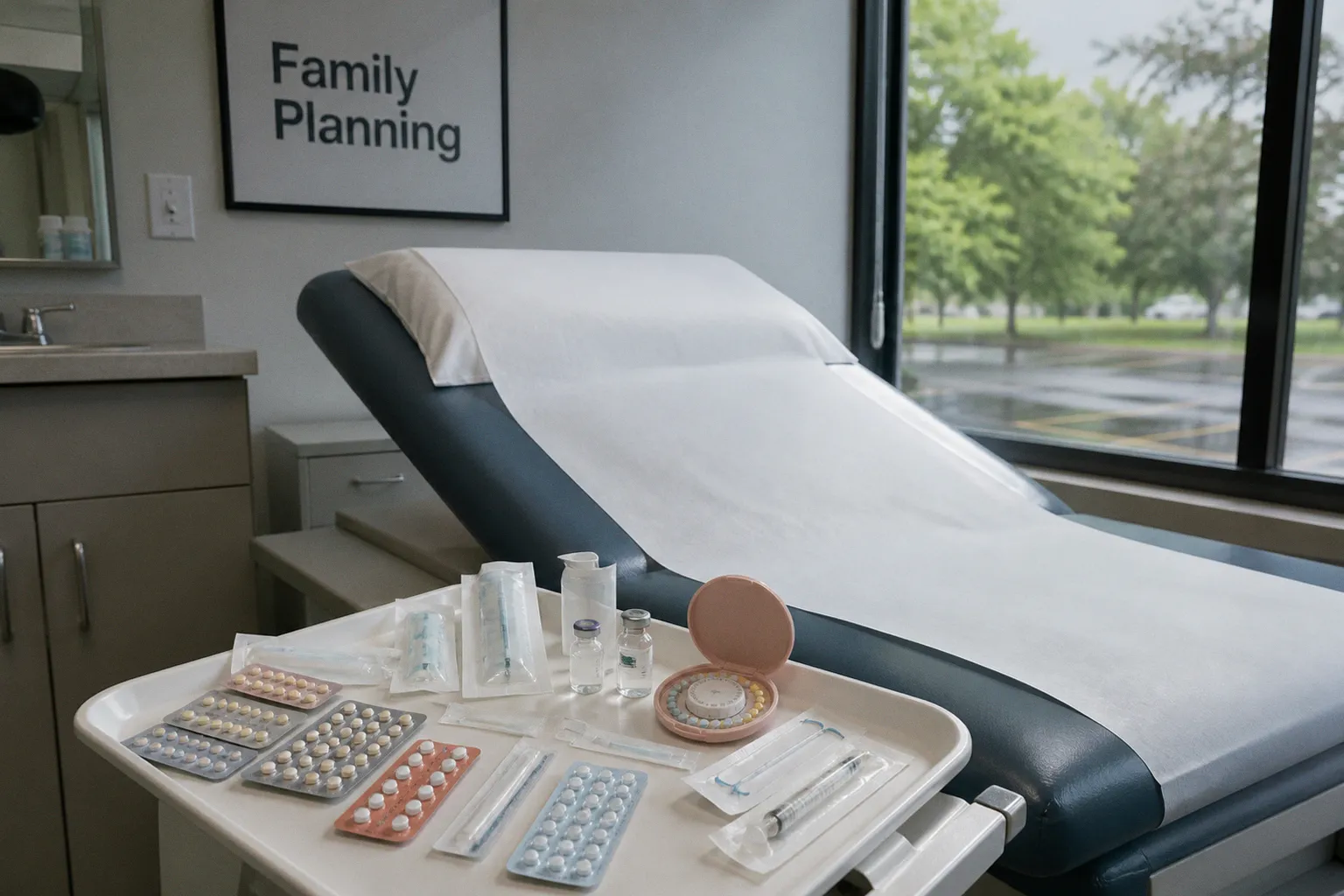
A monthly pill may cost as little as a discounted generic prescription at a retail pharmacy—or substantially more through a private clinic. An IUD or implant can involve an upfront bill of several hundred dollars, even though it may be cost-effective over time. A visit that appears routine can become financially out of reach once consultation, laboratory work, insertion, and follow-up are priced separately.
That does not mean uninsured patients have only one choice. The most useful contraceptive access options without insurance usually fall into five routes: Title X family planning clinics, Federally Qualified Health Centers, over-the-counter contraception such as Opill, manufacturer assistance programs, and retail or telehealth services that prescribe lower-cost pills. The right route depends less on the method’s list price than on whether you need a prescription, an in-person procedure, ongoing refills, or help paying for the visit itself.
The financial reality of uninsured reproductive care
The first distinction is between a medication and a service.
A prescription pill can be inexpensive once a clinician has authorized it, but an uninsured patient may still have to pay for the appointment. An IUD or implant is different: the cost may include the device, the insertion procedure, the clinician’s time, and sometimes testing or follow-up. Injectable contraception carries a recurring charge every three months, and the price may reflect both the medication and the administration visit.
Without insurance, oral contraceptive pills generally range from about $10 to $150 per month. That is a wide range because the prescription, brand, pharmacy, discount program, and dispensing arrangement all matter. Generic pills may be available at retail pharmacies for around $8 to $10 per month through discount programs, while branded products can cost much more.
Long-acting methods create a larger upfront hurdle:
- IUDs: approximately $500 to $1,300 without insurance, including the device and insertion in many quoted estimates, though actual charges vary by clinic.
- Contraceptive implants such as Nexplanon: roughly $600 to $1,300 without insurance.
- Depo-Provera injections: about $30 to $100 per dose every three months, before accounting for any separate visit or administration fee.
- Prescription pills: generally $10 to $150 per month without insurance, with generic discount pricing at the lower end of the range.
- Opill: the manufacturer’s suggested retail price is $19.99 for one month or $49.99 for three months.
These figures are useful for orientation, not as a promise of what a particular clinic or pharmacy will charge. The price of an IUD, for example, is not meaningful until a patient knows whether the quote includes insertion, the device itself, and a follow-up visit. A low advertised price may cover only one part of the care.
The cheapest contraceptive method on paper is not always the cheapest method to obtain. Access is a route, not just a price tag.
For an uninsured patient, the practical questions are usually:
1. Do I need a clinician to prescribe or administer the method?
2. Can I pay a fee at the time of service, or do I need income-based assistance?
3. Is the method available locally, or will I need to travel?
4. Will I need a separate appointment for insertion, injection, or follow-up?
5. Can I reliably return for refills or repeat doses?
Those questions narrow the field more effectively than comparing methods in the abstract.
Title X clinics and safety-net providers
Title X family planning clinics are often the strongest starting point for uninsured patients who need both a contraceptive method and an affordable clinical visit. The federal Title X program, established in 1970, supports family planning and preventive reproductive health services through participating providers. Clinics generally use a sliding-fee scale, so the amount a patient pays is tied to household income.
Patients with household incomes at or below 100% of the federal poverty level qualify for a 100% fee discount for Title X services. That does not mean every possible service, medication, or procedure is automatically free in every location, but it creates a meaningful route to no-cost or very low-cost care. In 2023, Title X providers served approximately 2.8 million people. Around 60% of clients qualified for zero-cost services because their family income was at or below that threshold, and 27% lacked health insurance entirely.
The value of a Title X clinic is not limited to the contraceptive product. A patient may be able to discuss pills, injections, implants, and IUDs in one setting, receive a prescription, and learn which options the clinic can provide at a reduced price. Many clinics also connect patients with testing, counseling, and follow-up care when those services are within the program’s scope.
Federally Qualified Health Centers, or FQHCs, are another important safety-net route. They serve patients regardless of ability to pay and commonly use income-based fees. FQHCs are not identical to Title X clinics: a health center may offer a broader range of primary care, while a Title X provider is specifically funded for family planning services. Some organizations participate in both systems.
A clinic’s funding status does not guarantee that every contraceptive method is in stock. In particular, patients should not assume that an IUD or implant can be inserted on the day of the first appointment. Availability depends on the provider, inventory, clinician schedules, local protocols, and the patient’s clinical circumstances.
Why the 340B program can change the medication price
Some safety-net providers participate in the federal 340B Drug Pricing Program. It allows eligible organizations, including many clinics and health centers, to obtain outpatient medications at discounted prices. When a provider uses that purchasing structure, oral contraceptives and injections may be available to uninsured patients at a deep discount or nominal fee.
The benefit is most visible when the clinic dispenses the medication directly or has a defined arrangement for reduced-cost prescriptions. A patient who receives a prescription and takes it to an unrelated pharmacy may not receive the same price. This is why the question to ask is not simply whether the clinic offers birth control, but whether it can dispense the method at its reduced uninsured rate.
When contacting a Title X clinic or FQHC, a short set of practical questions can save a wasted trip:
- Does the clinic use a sliding-fee scale for uninsured patients?
- What documents are used to determine household income?
- Which methods are available at reduced cost?
- Does the quoted price include the visit, medication, device, insertion, or administration?
- Can the clinic provide a same-day prescription or method, or is a second appointment required?
- If the clinic cannot provide the method, does it refer patients to another low-cost provider?
The answers matter more than a general label such as “affordable care.” A clinic may be inexpensive for a pill but unable to provide an implant locally. Another may offer IUD insertion but require a separate consultation first.
Over-the-counter contraception: what Opill changes—and what it does not
Opill introduced a different access model in the United States. The FDA approved it in July 2023 as the first daily oral contraceptive available over the counter. Because it does not require a prescription, a person can purchase it through a retail channel without scheduling a clinician visit solely to obtain authorization.
The manufacturer’s suggested retail price is $19.99 for a one-month supply and $49.99 for a three-month supply. That makes the three-month package less expensive per month than buying a single month at the suggested price. Retail prices, promotions, and local availability can differ, however, and not every store will stock it in the same way.
Opill can be particularly useful for someone who:
- wants a daily pill rather than a procedure;
- does not have insurance or cannot arrange a timely appointment;
- can pay the retail price directly;
- prefers to avoid a prescription visit;
- can follow daily dosing instructions consistently.
Its over-the-counter status removes one barrier, not every barrier. It does not make the product free. It also does not replace a clinical conversation when a person has questions about whether a progestin-only pill is appropriate, how to manage missed doses, or how to respond to side effects. A pharmacist or clinician can be a useful source of individualized guidance, especially if the patient takes other medications or has a relevant medical history.
The Affordable Care Act’s contraceptive mandate should not be confused with over-the-counter access. The mandate requires most private health plans and Medicaid expansion programs to cover FDA-approved contraceptive methods without cost-sharing, subject to the rules and exemptions that apply to a particular plan. It does not create federal coverage for an uninsured person, and it does not automatically make nonprescription contraception free.
That difference is central. An insured patient may have a path to no-cost prescription contraception through a health plan. An uninsured patient using Opill generally encounters a retail purchase rather than a covered medical benefit.
Long-acting methods through patient assistance programs
IUDs and implants are attractive to many patients because they provide contraception for an extended period without requiring a daily pill or a three-month injection. The obstacle for uninsured patients is often not the method’s long-term value but the initial bill. A device that costs hundreds of dollars upfront may be impossible to purchase even when the patient would spend less over time than on monthly contraception.
Manufacturer Patient Assistance Programs, or PAPs, can sometimes bridge that gap. Certain pharmaceutical manufacturers offer programs that provide free long-acting contraceptives, including some Mirena and Paragard IUDs, or injectable contraception such as Depo-Provera, to qualifying low-income uninsured patients. Eligibility rules differ by product and program. Applications may be handled through a clinician, clinic, or enrollment process rather than directly at the pharmacy counter.
This route is most promising when a patient already has a clinic willing to help with the application and provide the procedure. Assistance with the device does not necessarily mean that every related service is covered. The insertion, removal, consultation, laboratory work, or follow-up may be billed separately unless the participating provider has another source of financial support.
That makes the sequence important:
How to pursue assistance for a long-acting method
1. Choose the type of method you are considering. An IUD and an implant require different procedures and may be supplied through different programs.
2. Find a participating clinic. A manufacturer program may require a healthcare professional to submit or verify the application.
3. Ask what the assistance covers. Confirm whether it applies to the device only or also to insertion and related care.
4. Request the total uninsured estimate. A clinic should be able to explain which charges remain after assistance is approved.
5. Clarify timing. Approval, shipment, scheduling, and insertion may occur on separate dates.
6. Ask about removal and follow-up. Those services may not be included in the original assistance.
The same principle applies to injections. A reduced-cost dose is helpful only if the patient can also access the recurring visit required to receive it. For someone with unstable transportation or unpredictable work hours, a method that requires fewer appointments may be more practical—even if its initial acquisition process is more involved.
Retail pharmacies, generic pills, and telehealth
For patients seeking a prescription pill, the retail pharmacy can be the most direct route after a prescription has been obtained. Generic birth control pills may be available through pharmacy discount programs for approximately $8 to $10 per month at some large retailers, including Walmart and Target. These are not universal prices, and they may not apply to every formulation or every store, but they show why comparing the cash price of a generic can be worthwhile.
The key detail is the exact product. A discount price for one generic pill does not automatically apply to a different formulation, brand, or dosage. Patients should ask the prescriber whether an appropriate generic equivalent is available and then compare the pharmacy’s cash price before the prescription is sent or transferred.
Telehealth can reduce the logistical cost of obtaining a prescription, but it does not necessarily make contraception free. The total price may include:
- the telehealth consultation;
- the prescription itself;
- the pharmacy’s cash price;
- follow-up or renewal fees;
- additional charges if the service requires laboratory work.
That is why “telehealth birth control cost” should be treated as a total-visit question rather than a single advertised consultation fee. A low initial price can become less attractive if refills require repeated paid visits. On the other hand, telehealth may be a practical option for someone who lives far from a clinic, has limited transportation, or needs a routine pill prescription rather than an in-person procedure.
A useful comparison looks like this:
| Access route | Best fit | Main cost structure | Main limitation |
|---|---|---|---|
| Title X family planning clinic | Uninsured patients who need income-based pricing and clinical guidance | Sliding fee; patients at or below 100% of the federal poverty level qualify for a 100% fee discount for Title X services | Method availability and appointment timing vary |
| FQHC | Patients who want broader primary and reproductive healthcare in a safety-net setting | Income-based fees; medication discounts may apply through safety-net purchasing programs | Not every center stocks every contraceptive method or offers same-day insertion |
| Opill over the counter | Patients who want a daily pill without a prescription visit | Suggested retail price of $19.99 for one month or $49.99 for three months | It is not automatically covered or free for uninsured patients |
| Manufacturer assistance | Low-income uninsured patients seeking certain long-acting or injectable methods | Some programs may provide the product at no cost if eligibility requirements are met | Device assistance may not cover insertion, visits, or follow-up |
| Retail generic prescription | Patients who already have a prescription and need the lowest pharmacy cash price | Some generic programs list prices around $8 to $10 per month | Prices depend on the exact medication, pharmacy, and local program |
| Telehealth | Patients who need a prescription but face travel, scheduling, or privacy barriers | Consultation plus pharmacy cost, with possible renewal fees | A remote visit may not solve the cost of the medication or provide procedures |
The most economical option depends on the barrier that is actually blocking care. If the problem is the consultation fee, a discounted pharmacy price is not enough. If the problem is transportation, a clinic with a sliding scale may still be inaccessible. If the priority is a method that lasts for years, a monthly pill price does not answer the question.
How to choose a route without losing time or money
A practical decision begins with the method, then works backward to the access point.
If you want a pill and need it quickly, compare Opill with the total cost of obtaining a prescription for a generic pill. Opill avoids the prescription step, while a generic prescription may be cheaper per month through a retail discount program. The better option depends on the price available where you live and whether you can arrange a low-cost consultation.
If you want an IUD or implant, start with Title X clinics, FQHCs, and providers that help uninsured patients apply for manufacturer assistance. Asking a private clinic for its standard self-pay price may produce the highest number in the comparison, while a safety-net provider may be able to combine sliding-scale care, discounted medication acquisition, and assistance funding.
If you prefer injections, compare the price of each dose with the cost of the required visit and the transportation involved. A $30 medication price does not describe the full expense if the clinic charges a separate administration fee or if each appointment requires a long trip.
If you have recently lost insurance or may qualify for public coverage, ask about Medicaid eligibility and state-specific reproductive health programs. Medicaid expansion programs are subject to the ACA contraceptive coverage framework, but eligibility and enrollment pathways differ by state. A clinic, enrollment assister, or local health department may be able to explain whether you qualify and when coverage would begin. Do not assume that an application automatically covers care received before enrollment.
Before booking, write down the exact questions that determine the final price:
- Is the provider serving uninsured patients?
- Is the fee based on household income?
- What does the quoted price include?
- Is the contraceptive method in stock?
- Can the method be provided during the first visit?
- Are laboratory tests required, and are they billed separately?
- What will refills, injections, insertion, removal, or follow-up cost?
- Does the clinic help with manufacturer assistance applications?
- If the clinic cannot provide the method, where does it refer uninsured patients?
This is not bureaucratic overkill. In reproductive healthcare, the difference between a manageable bill and an impossible one is often hidden in the second appointment or an unmentioned procedure fee.
A workable access plan is one that matches the method to the patient’s money, time, transportation, and ability to return—not merely the method with the lowest advertised price.
The route matters as much as the method
Uninsured patients are often told to compare contraceptive methods as if the clinical choice were separate from the healthcare system that delivers it. In practice, access determines what is realistic. A pill may be clinically acceptable but difficult to refill. An IUD may be financially viable through assistance but unavailable at the nearest clinic. Telehealth may solve the appointment problem while leaving the pharmacy bill untouched.
Title X clinics and FQHCs are usually the best first calls when income-based pricing is necessary. Opill provides a prescription-free alternative for people who can pay the retail price and prefer a daily pill. Retail pharmacy discounts may make generic prescriptions affordable once a clinician is involved. Manufacturer assistance can change the calculation for certain long-acting and injectable methods, especially when a clinic helps coordinate the application and procedure.
There is no single cheapest pathway for every uninsured patient. The strongest strategy is to ask for the total cost, identify which part of care is creating the barrier, and choose the access route that addresses that barrier directly. Affordable contraceptive options exist, but they are distributed across clinics, pharmacies, assistance programs, and public coverage systems. Knowing where to start is often the first meaningful reduction in cost.