Plan B weight limits: what is the BMI cutoff?
The label on a box of Plan B One-Step lists no weight limit, no BMI cutoff, and no body-size contraindication. In the United States, the product is available over the counter regardless of how much the person buying it weighs.
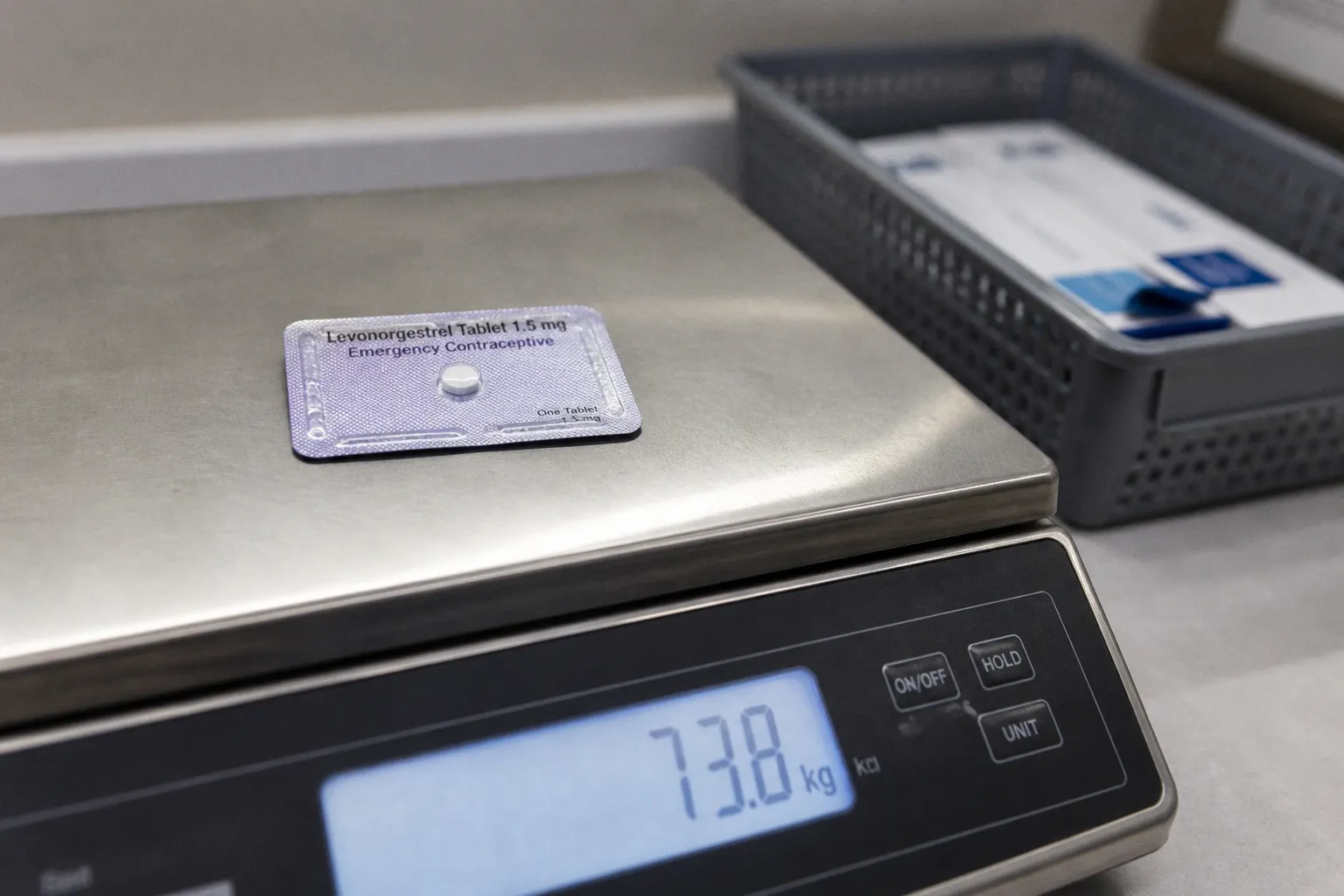
The Reality of Levonorgestrel and Body Weight: Separating Fact from Fiction
And yet, layered on top of that official regulatory silence sits more than a decade of clinical evidence suggesting that the active ingredient — levonorgestrel 1.5 mg — does not work equally well across the weight spectrum.
That gap between what the label permits and what the research suggests is precisely where most readers get stuck. It is also the question that matters most when someone is standing in a pharmacy aisle late at night, trying to decide whether the option in front of them is actually likely to do what they need it to do.
The honest answer is more complicated than a yes-or-no. Plan B remains a legitimate, accessible, and useful form of emergency contraception for many people who take it promptly. But for people at higher body weights, the available evidence points to a meaningful decline in effectiveness. That does not make levonorgestrel unsafe, and it does not turn a single number on a scale into a medical prohibition. It does change which option deserves to be considered first.
Understanding the 165-Pound Threshold and BMI Correlation
The number 165 pounds, or about 75 kilograms, gets quoted constantly, and for understandable reasons. It traces back to a 2011 meta-analysis by Glasier and colleagues, which pooled data from several large emergency contraception trials. The analysis found that among women with a BMI over 30 kg/m², the pregnancy rate after taking levonorgestrel-based emergency contraception was roughly three times higher than among women with a BMI under 25.
Earlier signals in the research suggested that efficacy might begin to decline somewhere between 155 and 165 pounds. That range became a practical benchmark in patient education and clinical discussions, even though it is not a formal cutoff printed on the Plan B label. It is better understood as a warning zone in the evidence than as a line separating people for whom the pill works from people for whom it does not.
Plan B has no weight limit on its label — but the clinical evidence suggests that its efficacy can start sliding before many users expect.
Researchers often use Body Mass Index rather than weight alone because BMI accounts, imperfectly, for height as well as mass. The commonly discussed categories look like this:
- BMI under 25 kg/m²: This is the range in which levonorgestrel has generally performed most consistently in clinical trials.
- BMI between 25 and 30 kg/m²: This is the range in which some aggregated data suggest that effectiveness may begin to decline, although the evidence is not a precise prediction for any individual.
- BMI of 30 kg/m² or higher: This is the range associated with the clearest concern in the 2011 analysis, including the reported increase in pregnancy risk after levonorgestrel use.
Those categories are useful for understanding the research, but they should not be mistaken for a personal forecast. BMI is an imperfect proxy for body composition, and a single weight number is an even rougher one. Two people at the same weight can have different patterns of fat distribution, metabolism, medication absorption, and reproductive timing. The studies do not allow a clinician to look at a person’s BMI and calculate an exact chance that Plan B will work.
The mechanism is also not completely settled. Levonorgestrel emergency contraception works mainly by delaying ovulation, and its performance depends heavily on where someone is in their cycle when they take it. Body composition may affect how the drug is absorbed, distributed, metabolized, or cleared. A higher body mass could result in lower drug exposure at the point when ovulation needs to be delayed, but the precise biological explanation remains incompletely mapped.
What is clearer is the direction of the concern: in the available data, levonorgestrel appears less reliable on average at higher body weights. That is a population-level finding, not proof that the medication will fail for every person above 165 pounds. Nor does it mean that the medication has no value. Emergency contraception is time-sensitive, and taking a medication with reduced expected efficacy may still be preferable to taking nothing when other options are not immediately available.
Why the number is not a hard cutoff
The 165-pound figure is often presented as though it were a switch: effective below the line, ineffective above it. Biology rarely behaves that neatly.
The studies found patterns across groups of people. They did not establish a moment at which levonorgestrel suddenly stops working. A person weighing 164 pounds is not categorically protected, while a person weighing 166 pounds is not categorically unprotected. Height, cycle timing, whether ovulation has already begun, interactions with other medications, and how quickly the pill is taken all matter.
This is why clinical counseling tends to use language such as reduced efficacy, higher BMI, or a preferred alternative rather than declaring Plan B off-limits. The label remains the same for everyone, but the evidence can still be relevant to choosing among available methods.
Why Doubling the Dose Is Not a Clinically Supported Solution
The logic feels intuitive: if one pill may not provide enough medication, two pills must work better. A team at Oregon Health & Science University tested that assumption, and the results published in 2022 were not encouraging for anyone hoping a simple dose adjustment would solve the problem.
A double dose of levonorgestrel did not restore full efficacy for people in higher BMI categories. The finding matters because the workaround circulates widely online, in forums, in well-meaning advice from friends, and sometimes in older guidance that has not kept pace with newer evidence. The instinct to take more is understandable. It is also not supported as a reliable way to overcome the weight-related concern.
Emergency contraception is not a linear drug in the sense that more automatically means proportionally more protection. Levonorgestrel works primarily by delaying ovulation before the luteinizing hormone surge has advanced too far. Once that biological process is underway, increasing the amount of medication may not reverse it. A larger dose also does not necessarily correct the pharmacokinetic factor that may be reducing drug exposure in the first place.
The practical distinction is important:
| Concern | What the evidence supports |
|---|---|
| Can a double dose compensate for higher BMI? | Available evidence does not show that doubling levonorgestrel reliably restores efficacy. |
| Is there an FDA weight warning on the Plan B label? | No weight-limit warning appears on the Plan B label. |
| Is Plan B unsafe for people at higher weights? | The concern is reduced effectiveness, not a special safety danger created by body weight alone. |
| Should someone automatically skip Plan B above 165 pounds? | Not necessarily. It may still offer some benefit, but alternatives may be preferable when they can be obtained promptly. |
| Is taking two different emergency contraceptive pills a better strategy? | Not without clinical advice. Different products have different mechanisms and instructions, and combining them can create confusion rather than better protection. |
The useful response to uncertainty is not to improvise a higher dose. It is to consider whether a method with stronger evidence at higher body weights is realistically available within the relevant time window.
Alternative Emergency Contraception Options for Higher BMI
For people whose weight or BMI places them in the range where levonorgestrel’s effectiveness is a concern, two alternatives are especially important: ulipristal acetate, sold as ella, and the copper IUD. They are not interchangeable in terms of access. One is a prescription tablet; the other requires an in-person procedure. Both can be more appropriate than levonorgestrel in particular circumstances.
The decision also depends on timing. Emergency contraception works best before ovulation, and taking a method sooner is generally better than waiting while trying to find a theoretically ideal option. A method that is slightly more suitable on paper but unavailable until after the relevant window is not a practical solution.
Ulipristal acetate (ella)
Ella is the brand name for ulipristal acetate, a 30 mg single-dose emergency contraceptive that works differently from levonorgestrel. Levonorgestrel primarily delays ovulation before the luteinizing hormone surge has begun. Ulipristal can delay ovulation later in that process, which gives it a broader useful window for some people.
Its effectiveness appears to hold up better at higher body weights than levonorgestrel’s, although it is not completely weight-independent. Research and clinical materials commonly place the area of greatest concern at a higher weight or BMI range — roughly around 195 pounds, or a BMI in the 30–35 range — rather than treating ulipristal as immune to the same issue. The available evidence is not a guarantee above or below any one number.
Ella is approved for use up to 120 hours, or five days, after unprotected intercourse. That does not mean every person receives the same level of protection throughout those five days. Earlier use is still preferable, and the medication cannot prevent a pregnancy that has already been established.
The access problem is straightforward: in the United States, ella requires a prescription. Depending on the area, that may mean telehealth, a primary-care appointment, a sexual-health clinic, or another service able to prescribe emergency contraception quickly. It is worth checking whether the prescriber can send the prescription to a pharmacy that actually has the medication in stock. A prescription that cannot be filled promptly does not solve the immediate problem.
There is also a follow-up issue. Because ulipristal and hormonal contraceptives can interact in a way that affects their action, people who use ella should follow the product instructions or ask a clinician or pharmacist when to start or restart hormonal birth control. Barrier protection may be needed during that interval. This is one of the reasons not to combine ella with levonorgestrel on one’s own.
The copper IUD
The copper IUD is the option reproductive-health clinicians often describe as the gold standard for emergency contraception. It is highly effective, does not depend on the user remembering another dose, and provides ongoing contraception if the person chooses to leave it in place.
A copper IUD inserted by a trained clinician is generally used for emergency contraception within five days, or 120 hours, of the first act of unprotected intercourse. Some clinical guidance also allows placement later than 120 hours after intercourse when ovulation can be estimated and the device is placed within the clinically accepted interval after ovulation. In other words, the timing is not governed by one universal stopwatch. Eligibility depends on the date of intercourse, the estimated timing of ovulation, the relevant guidance, and a clinician’s assessment.
That distinction matters. Saying that the 120-hour point is an absolute ceiling for every copper-IUD scenario is too simple. It is also not a reason to delay. The person seeking emergency contraception should contact a clinic as soon as possible, explain the timing of intercourse, and ask whether copper-IUD placement is still clinically appropriate.
The copper IUD’s effectiveness does not depend on body weight or BMI in the way oral emergency contraceptives may. It works locally in the reproductive tract, where copper interferes with sperm movement and function and helps prevent fertilization. It can also prevent pregnancy through effects on the uterine environment. The mechanism is not dependent on achieving a particular concentration of a systemic medication in the bloodstream.
The trade-offs are real:
- It requires an appointment. The insertion must be performed by a trained clinician, such as a gynecologist, family-planning provider, or other clinician with appropriate training.
- The procedure can be uncomfortable. Insertion involves a pelvic examination, and people experience the procedure differently. Some clinics discuss pain-relief options, including local numbing.
- It is a longer-term decision if left in place. The device can provide contraception for years, but it can also be removed if the user does not want ongoing use.
- Access varies. Geography, clinic capacity, insurance, transportation, scheduling, and whether a provider offers same-day insertion can all determine whether it is realistic in an emergency.
- The method may not suit everyone. A clinician will review medical history, pregnancy risk, infection concerns, bleeding patterns, and other factors before insertion.
For someone already considering a long-term, nonhormonal contraceptive method, the copper IUD can address both the immediate emergency and future contraception in one visit. For someone who needs a pill immediately and cannot obtain an appointment, levonorgestrel or ulipristal may still be the available path.
The Gold Standard: Why Copper IUDs Remain Weight-Independent
It is worth pausing on why the copper IUD sidesteps the weight question. The drug-based options — levonorgestrel and ulipristal acetate — circulate systemically. They need to reach the relevant tissues and alter the hormonal events leading to ovulation. Body composition can affect how a medication is distributed, metabolized, and cleared. That is the pharmacokinetic context behind the BMI gradient, even though the exact mechanism for levonorgestrel remains incompletely defined.
The copper IUD works differently. There is no tablet whose concentration has to reach a particular level in the bloodstream. The device sits inside the uterus and releases copper ions locally, changing the environment in which sperm would otherwise move and function. Whether a person weighs 130 pounds or 230 pounds does not create the same concern about diluting a single oral dose at the site of action.
That is why the copper IUD is often the strongest option for people who want emergency contraception without a body-weight-related reduction in expected efficacy. It is not necessarily the easiest option, and “most effective” does not mean “best for every person.” A method can be clinically excellent and still be inaccessible, unwanted, or too burdensome to arrange during a time-sensitive situation.
When body weight complicates drug-based emergency contraception, the copper IUD is the option that sidesteps the scale rather than asking one pill to overcome it.
A practical access strategy is to call before traveling. Planned Parenthood affiliates, sexual-health clinics, university health centers, and some gynecology practices may offer copper-IUD insertion, but services differ by location. Ask specifically whether the clinic provides emergency contraception with a copper IUD, whether same-day or next-day appointments are available, and what information is needed about the timing of intercourse and the last menstrual period.
Do not assume that a general urgent-care clinic can place an IUD simply because it treats reproductive-health concerns. Likewise, do not assume that a clinic offering routine IUD insertion can accommodate an emergency appointment on short notice. Calling ahead can save the most valuable resource in this situation: time.
Putting It Together: A Decision Framework Without Dogma
For someone making the decision in real time, the options may look something like this:
1. Within 72 hours, with no immediate clinic access and a body weight below the range where reduced levonorgestrel efficacy is most concerning: Plan B or a generic levonorgestrel product is a reasonable, accessible option. Take it as soon as possible rather than waiting for the perfect choice to appear.
2. Within 120 hours, with a prescription available quickly: Ulipristal acetate may be the stronger oral option, particularly when body weight or BMI makes levonorgestrel less attractive. It is also useful later in the five-day window, although earlier use remains preferable.
3. Within the clinically appropriate window and with access to a qualified provider: A copper IUD is the most effective emergency contraceptive option and is not affected by body weight or BMI. The relevant timing may be based on intercourse and, in some clinical guidance, estimated ovulation, so a clinic should assess eligibility rather than relying on a rigid rule.
4. More than 120 hours after intercourse: Do not assume that every option is automatically ruled out. Copper-IUD placement may still be possible in some circumstances depending on estimated ovulation and clinical guidance. Contact a qualified provider promptly for an individual assessment. Oral emergency contraception becomes more dependent on timing and may no longer be appropriate.
5. If no emergency method can be obtained: A clinician or pharmacist can help with next steps, including when pregnancy testing is likely to be informative and whether ongoing contraception should be started or adjusted.
There is also a gray zone for people whose weight falls between the commonly cited levonorgestrel and ulipristal thresholds. For them, the evidence offers directional guidance rather than a precise personal answer. One clinician may emphasize that partial efficacy is still preferable to no intervention. Another may recommend ella or a copper IUD if either can be obtained quickly. Both timing and access belong in that conversation.
The same is true for people who are close to the 165-pound benchmark but do not know their BMI, or who have irregular cycles and cannot estimate whether ovulation has occurred. There is no need to turn an emergency into a home calculation exercise. Weight and BMI are pieces of the decision, not substitutes for clinical judgment. If a medication is available now and an alternative would require a long delay, that difference may matter more than the apparent neatness of the cutoff.
A few practical facts should stay in view:
- Emergency contraception does not terminate an existing pregnancy. It works by preventing ovulation or fertilization before a pregnancy is established.
- Emergency contraception does not protect against sexually transmitted infections. Condoms and testing remain relevant when STI exposure is possible.
- Vomiting soon after taking an oral emergency contraceptive may affect absorption; follow the product instructions or contact a pharmacist for advice.
- Some medications and supplements can affect how hormonal emergency contraception works. A pharmacist or clinician can check for interactions.
- After using emergency contraception, a late or unusual period does not by itself answer whether pregnancy has occurred. Follow-up testing should be timed according to clinical advice and the product information.
Cost is part of access, but it is not responsible to attach a fixed current price range to every method. The amount someone pays can depend on insurance, public-health funding, the pharmacy, the clinic, the prescription route, and whether an IUD visit is covered. Some people may be able to obtain pills through a public clinic or insurance with little or no out-of-pocket cost; others may face a retail charge. Copper-IUD insertion can also be covered, partially covered, or expensive depending on the health system and provider. Asking the pharmacy or clinic about the total cost before committing is reasonable, but financial uncertainty should not be treated as evidence that one method is medically better than another.
The question that brings most readers to this page — whether there is a Plan B weight limit — does not have the clean answer the wording implies. There is no official weight limit on the Plan B label. There is a clinical reality in the data: levonorgestrel appears less reliable at higher body weights, with concern often discussed around 165 pounds and BMI ranges associated with obesity. That reality does not justify doubling the dose, and it does not mean the pill is unsafe or categorically useless.
It does mean that emergency contraception deserves more than a one-size-fits-all answer. When available, ulipristal acetate may be a stronger oral alternative, and the copper IUD remains the most effective, weight-independent option. The right choice is the one that fits the timing, the person’s health and preferences, and what can actually be accessed in time. Knowing those distinctions turns an alarming question about a number on the scale into a decision with real options.